This project received funding from the Amazon Gilroy Community Fund to support lasting impact in our community.

CLICK HERE to open the map in a separate tab.
This tour is a loop, and can be started from any point on the map. Scan the code on any building to jump to that building’s description, or scroll down the list below to find any address marked on the map.
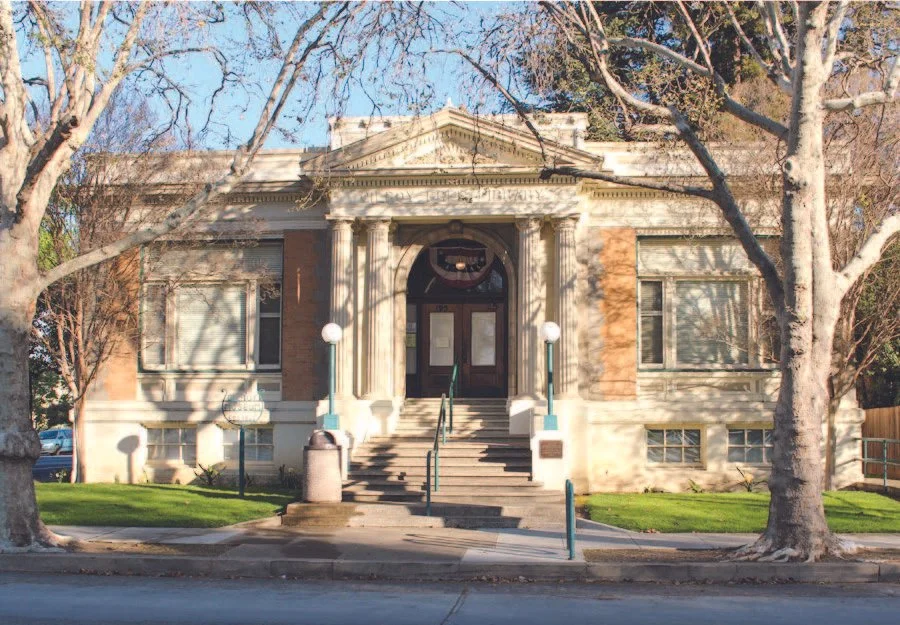
195 Fifth Street
(1910)
CARNEGIE FREE LIBRARY
In 1910 (after much debate) the City applied for a grant of $10,000 from Andrew Carnegie. His requirements were for the City to provide the lot, hire an architect and submit the plans to his office for approval. After the library was built the City had to provide books and furniture and hire the librarian, in perpetuity. Benefactor Caroline Hoxett purchased the lot (a former tennis court) and gave it to the City for building the library. Prominent Central Coast architect William Weeks was hired and the building was completed in July 1910.
This neoclassical design was a very popular architectural style for Carnegie libraries, especially in the West. The buff brick walls, distinctive quoins on the corners and full entablature add to the impressive Roman-style arched recessed entry. The paired fluted Doric columns add to the neoclassic design. Windows are simple and restrained. A rear segmental arched door defines the back entrance. The sensitive massing and scale provide a perfect transition from the commercial blocks to the east to the residential blocks to the west along Fifth St.
Andrew Carnegie is significant because of his contributions to our culture. He provided funding for 1600 similar libraries in the US and 1400 in England and Scotland. This made it possible for common people to access libraries without charge, thus the important words below the pediment, Gilroy Free Library. Another of his requirements was that his portrait be displayed and you will see it inside. The building served as Gilroy’s first library until we outgrew it and joined the County Library system in 1975. Since then this city-owned building has been the home of the Gilroy Museum, a fine research center. The significance of this beautiful building is magnified by its use as the repository of Gilroy’s historic artifacts and written history.
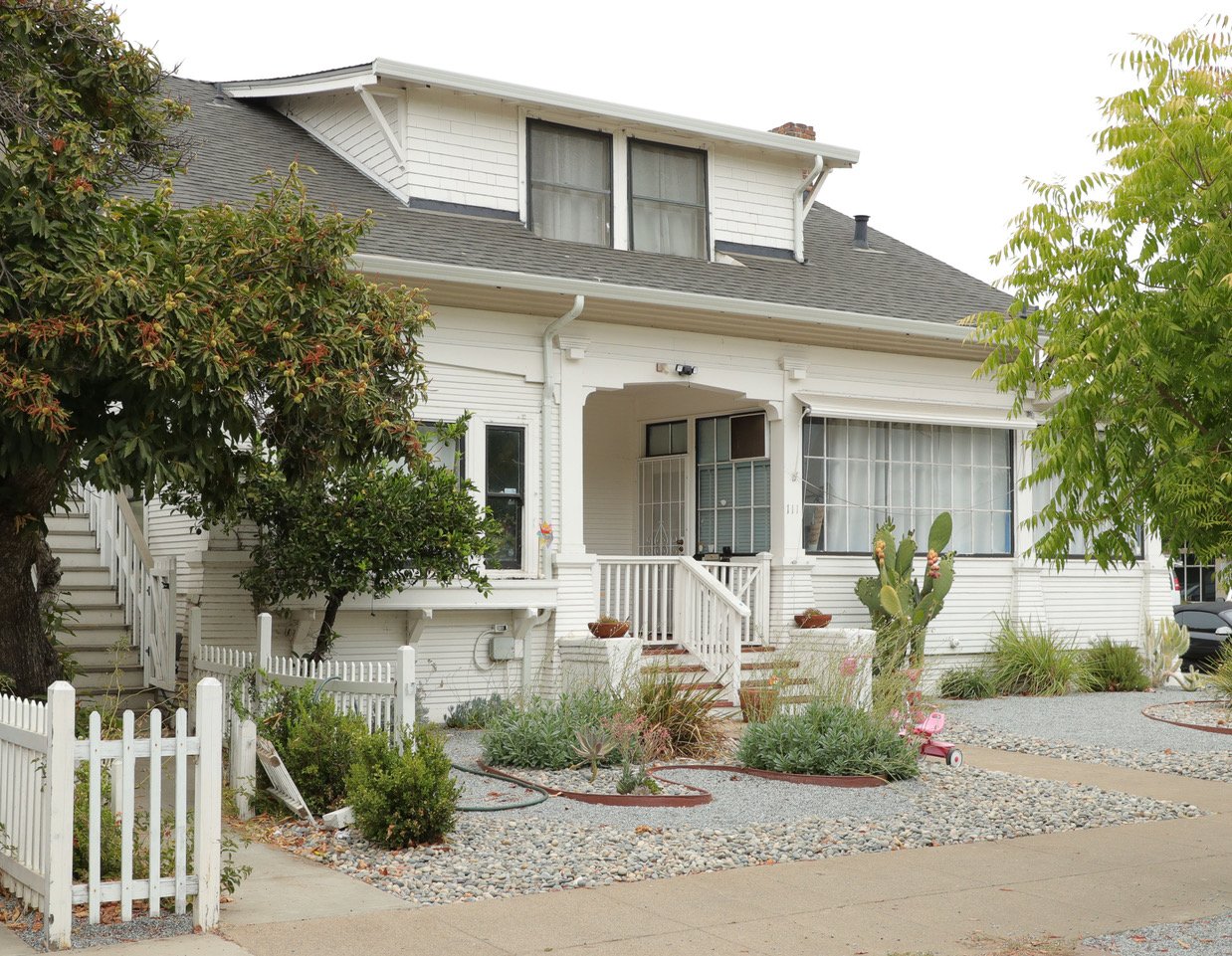
111 Fifth Street
(1912/1913)
JESSEN-MENKE HOUSE
This large Craftsman bungalow was designed by architect William Weeks and built in 1912-1913. Judge Howard Willey, who lived across the street at 140 Fifth Street, had it built as an investment property. The first tenant was Dr. John Clark, a respected physician. Next were Thara Jessen and Anne Menke who owned a dress shop on Monterey Street, followed by Teresa Filice who operated a beauty shop on the porch. Today it has been divided into apartments.
Hallmarks of the Craftsman style include the exposed rafters and the elephantine base columns supporting the porch. Horizontal sheathing of boards of varied widths accentuate the Craftsman design. A sculptured recessed frame surrounds the front window and is repeated around the front recessed entry. The double dormer on the second floor exhibits a float roof.
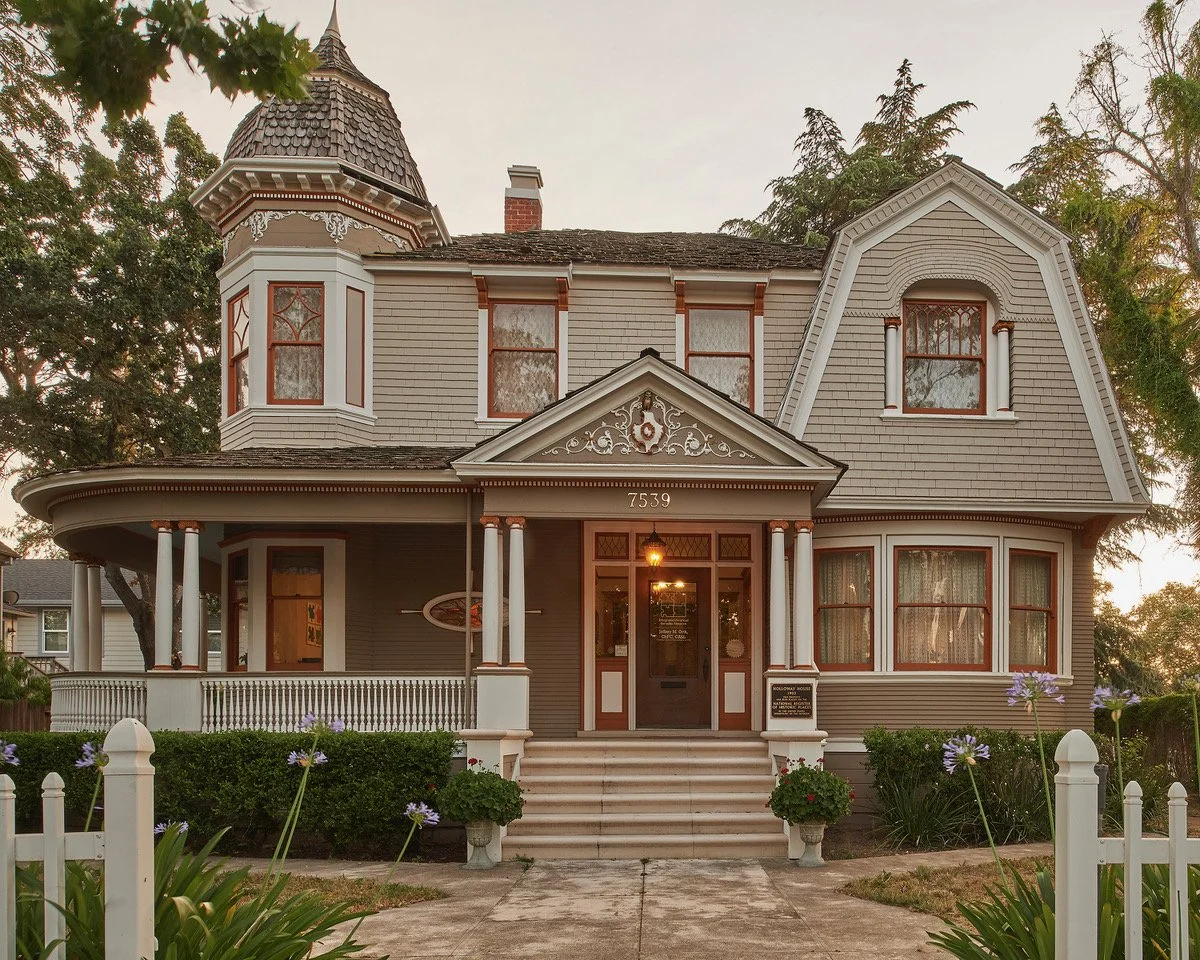
7539 Eigleberry Street
(1903)
HOLLOWAY HOUSE
Edgar and Dora Holloway, a prominent local couple, had the house built in 1903. In 1906 Mr. Holloway designed the sewer system and the electric plant for the City. Mrs. Holloway was a member of the Ellis Family who were important in dairying and financial affairs. After they both died in 1913 another successful family, the Barshingers, bought the house. They owned both a furniture and funeral home business. This was a common combination business practice during this period . During their tenure the home was a center of social activity. In 1956 the home was sold to William Hall who divided it into apartments. Twenty years later it became the home of a drug abuse and counseling agency. In 1982 the house was restored and placed on the National Register of Historic Places by business partners who had offices downstairs. An attorney’s office came next, including a period of neglect. The current owners bought the property in 2014 and restored the building to its former glory. There is a financial investment business on the first floor and an apartment on the second floor.
This highly ornamented Queen Anne Victorian home, built in 1903, was another design of famous central coast architect, William Weeks. The unique gambrel gables, (double sloped roof) have enclosed eaves and arched windows surrounded by round columns. The turret has brackets under enclosed eaves and a finial. Over the front door is a beautiful decorated pediment featuring an owl. A large open porch goes around nearly half the house and is supported by round columns. Additional features include a small oval window to the left of the front door, turned balusters under the porch railing and leaded glass in some of the windows facing the street. Original interior woodwork is beautiful.
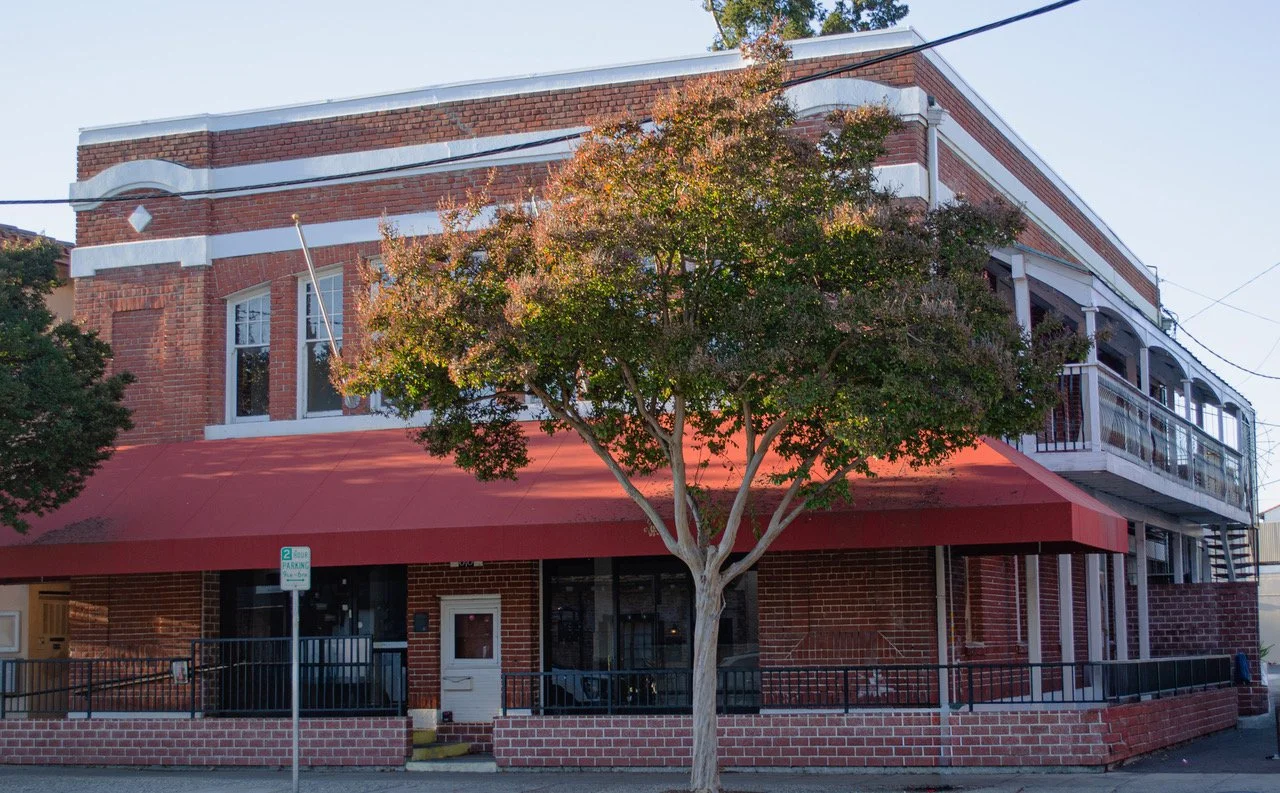
55 Fifth Street
(1916)
GILROY’S FIRST FIRE STATION
Gilroy’s first volunteer fire company in 1869 was the Vigilant Engine Company, composed of 35 men. Later the Eureka Hook and Ladder company formed, followed by the Neptune Hose Company which merged with Eureka. A heated rivalry ensued for a while, but after this station was built the two companies combined. The men slept upstairs and slid down the brass pole to make a quick getaway to the fire scene. In 1922 the City ordered a new Seagrave fire engine. There are photos of this engine and others along with history of the Gilroy fire department at the Gilroy Museum. This station served the City until 1978 when a modern fire station was built and this building was converted to a restaurant. In 1981 wooden balconies and a boardwalk were added on the eastside. Covered patio seating now obscures the beauty of the original design, but inside you will find the brass pole, tin ceiling and other historic features.
The purchase of Gilroy’s first motorized fire equipment, a chemical pumper, required the building of this fire station on the location of Gilroy’s original city hall. Prior to that fire equipment, probably a hose cart and bucket wagon, were stored on the first floor of Old City Hall. Architect William Binder designed this brick commercial style fire station which was built by William Radtke in 1916 for $5853. The decorative bands near the roofline provide relief from the brick façade. Below the bands is a broad arch of seven windows, each with a different shape. The second story provided for a club and meeting room along with sleeping quarters for those on duty. The original doors for fire trucks have now been replaced by large windows.
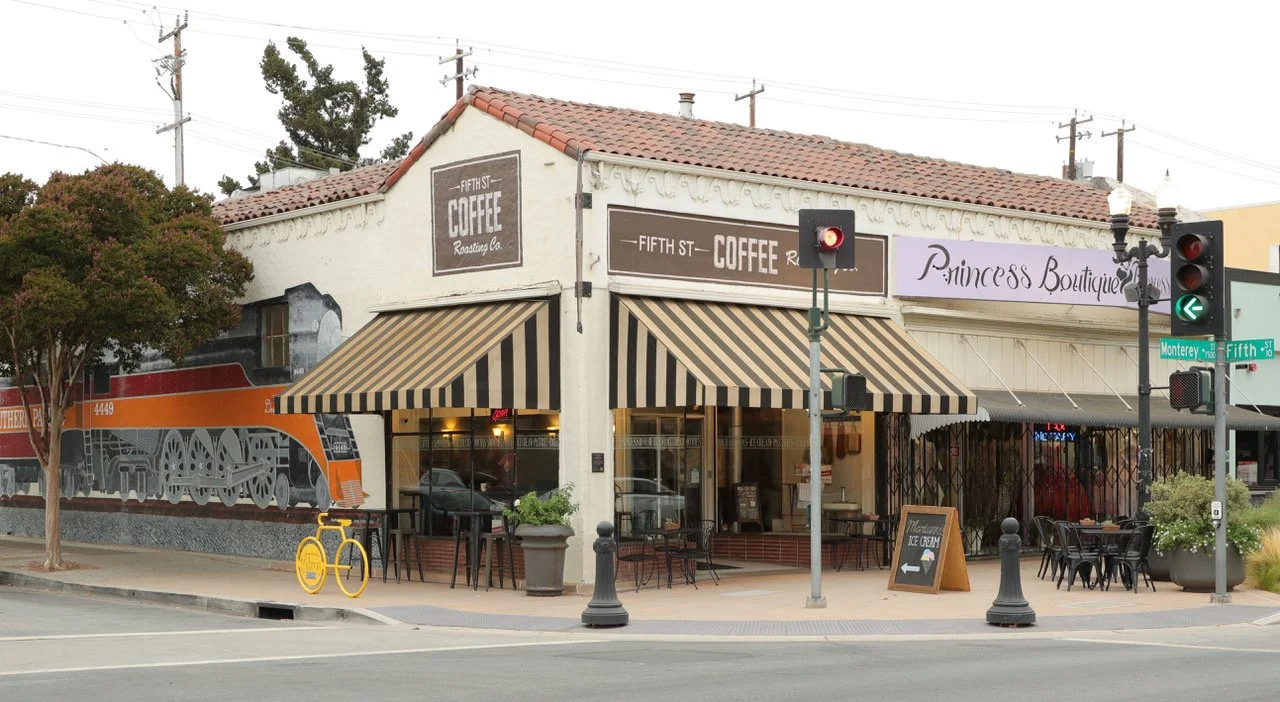
7501-07 Monterey Street
(1928)
This property was built in 1923 by William Radtke. It is a large, one-and-a-half story commercial building measuring 50’ x 142’ that is constructed on a rectangular plan and designed in a Spanish Colonial Revival style. Dominant features include the false, low-gabled red tile roof, the plain cornice, the oversized panels on the upper half story, the band of horizontal wooden boards which are placed in vertical strips over the first floor openings, and the projecting awnings. Decorative wooden detailing is located just below the shallow eave. The street front reinstates the standard commercial design with a recessed, double-door entry which is framed by large, plate glass windows with a 1950’s Roman brick base. Decorative shields ornament the Fifth Street elevation.
The commercial use of this building from its construction until the 1940’s was the D.B. Parks Auto Trimming and Harness Shop. Rizzuto’s Shoe Store occupied the north space during the 1950’s – 80’s. The current occupants are Fifth Street Coffee and Princess Boutique.
The historical and architectural importance of this building is primarily due to its builder, William Radtke, who constructed many of the residential and commercial buildings in Gilroy during the early parts of the 20th century. Buildings in downtown Gilroy before the construction of this building had three design styles: Mission Revival, Commercial, and Neoclassical. This building adds the Spanish Colonial Revival design to the architectural design mix of downtown. Spanish Colonial Revival design typically includes: stucco walls, red clay tile roofs, arches, wrought iron, wooden beams, courtyards and patios, ornamental tiles, small balconies, tower elements, and rounded chimneys. Adding this fourth design style to the city’s commercial core is historically and architecturally significant.
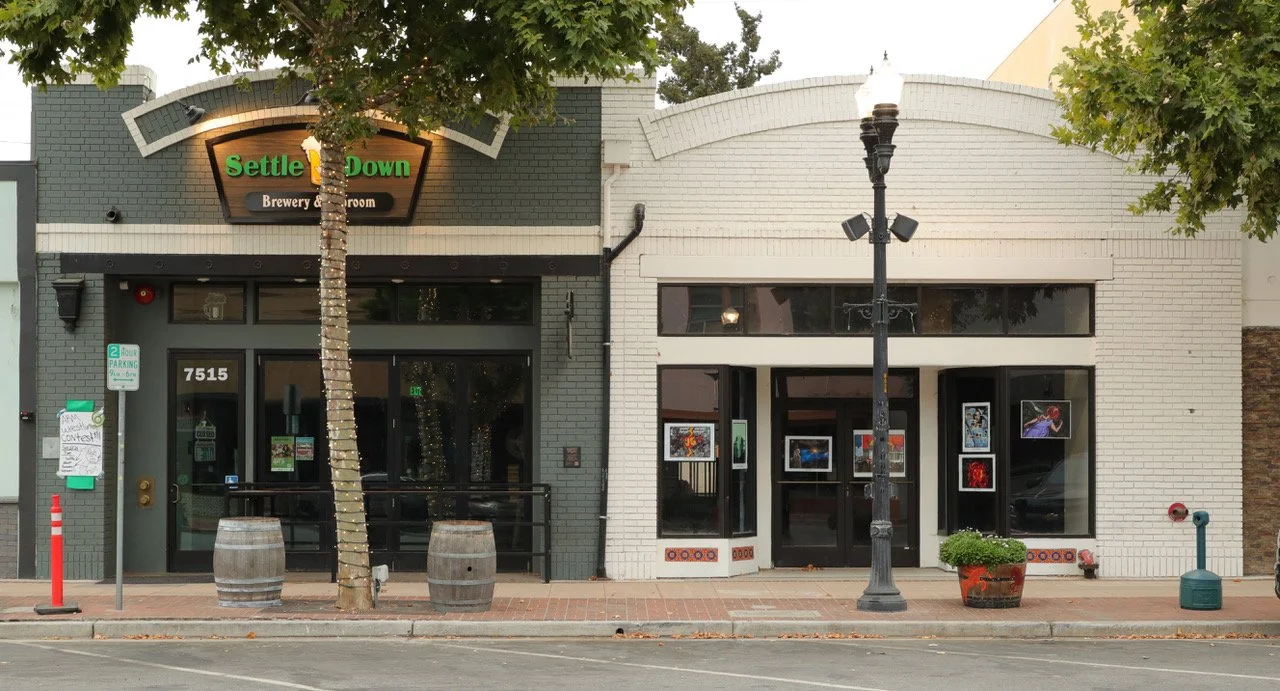
7515-17 Monterey Street (1921)
THORNTON BUILDING
Built in 1900, the Thornton Building has a rectangular footprint (50’ x 142’). It is a single-story brick commercial structure that has been somewhat altered on the street façade over the years and, later, when it was split into two separate business locations. The most distinctive feature of the structure is the variated parapet (wall sticking up above the roof that has varying height) along the roofline of the building, which is in the shape of an elongated, arched brick band. The cornice (wall / roof meeting point) is composed of bricks placed in a right angle to the horizontal placement of the façade wall. The entry doors are deeply recessed and composed of large plate glass in aluminum frames. The original basketweave mosaic tile entrance to the north doorway adds to the historical value. The alterations have not adversely affected the design quality of the structure or the basic composition of the building. Even with its altered looks, the Thornton building helps define the old Gilroy commercial district.
The historical and architectural significance of this building, commonly called The Thornton Building, includes a curved façade that is unique and important in the Monterey streetscape. Now a divided structure with two storefronts, it was originally one.
In 1931 this building housed the Heck & Bands California Market. It has been a music store and several other iterations including food and beverage services.
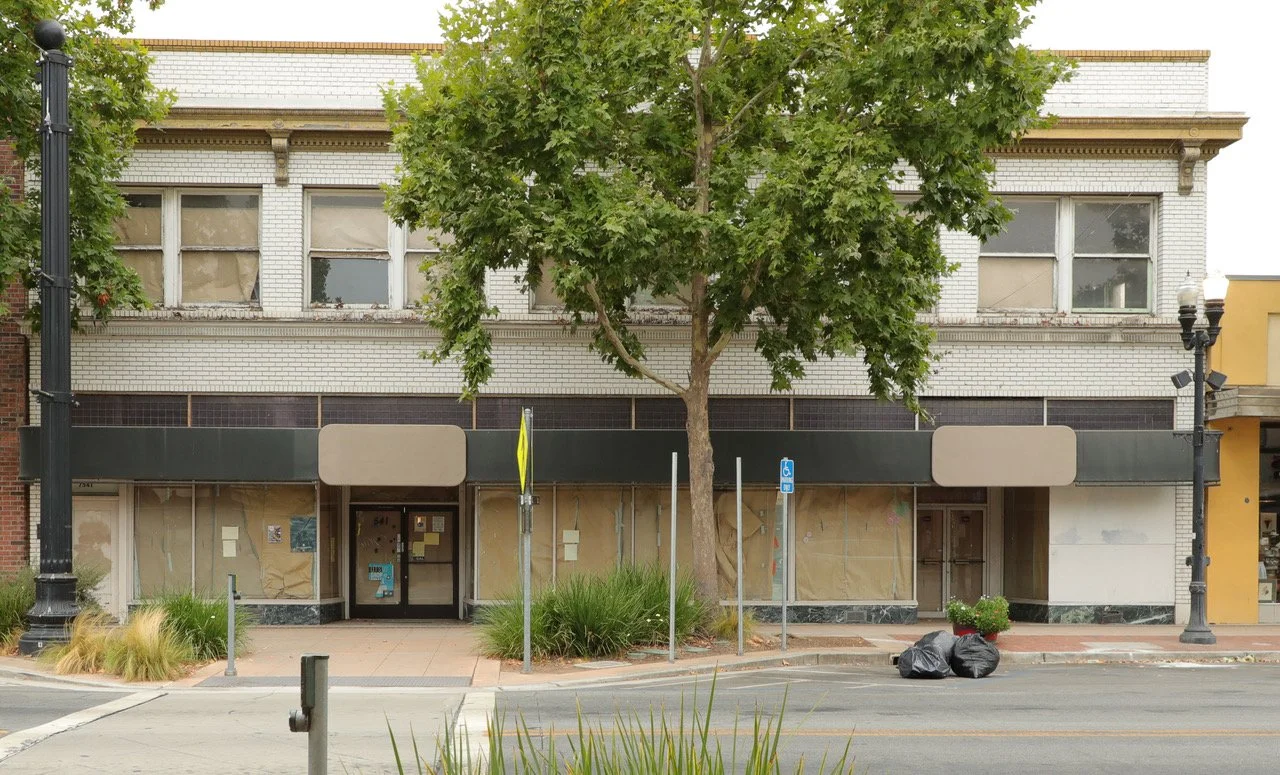
7541-43 Monterey Street
(1915)
ROBINSON HARDWARE
When constructed in 1915, the Robinson Building was a two-story hardware store established by Amos Robinson. Robinson’s wares included more than just hardware, they sold china, glassware, and home decorating items. Workers at the local canneries looked forward to a trip to Robinson’s to purchase some of the finer things in life. It was more like the proverbial general store - farming and building supplies, housewares, and other essentials for a small town.
This building is historically and architecturally significant for several reasons. It was designed by William Weeks, is an “anchor” building downtown and is listed by the City as an historic site. The attractive and interesting façade featured decorative friezes above and below the second story windows. A large “R” monogram at the center of the parapet (wall extension above the roofline) lends a distinctive touch to add to the historical value. The ground level floor housed Dick Bruhn’s and M’Lady Bruhns fashion clothing store for many years. Old photos reveal that at one point the upstairs was a hotel, entered by a door still visible on the street. The Robinson Building is a significant building in the Mainstreet streetscape of Monterey Road.
Known by the locals as Robinson Hardware, this handsome two-story brick building (64’ x 142’) is designed in an early 20th century commercial style with some slight neo-classical touches. It is one of the half dozen major buildings which give Gilroy’s central business district its architectural flavor and helps unify the surrounding smaller commercial buildings. The structure is constructed on a large rectangular plan with all of the design elements of the commercial style: a variated parapet (wall extension above the roofline), a pronounced cornice (wall/roof intersection) with oversized bracket and dentils; paired rectangular windows which are double hung and set in a band across the second story elevation; pronounced molded stringcourses separating floors, and the streetside band of large plate glass windows surrounding recessed glass double door entries with marble cladding on the base. The entire front elevation is covered in white glazed brick. Further detailing is provided by the decorative shield with an inscribed “R” which is centered under a centrally placed flagpole. The centered flagpole is a repeated element found on various downtown Gilroy commercial buildings which is a design holdover from the 19th century commercial buildings.
7579-81 Monterey Street
(1925/1926)
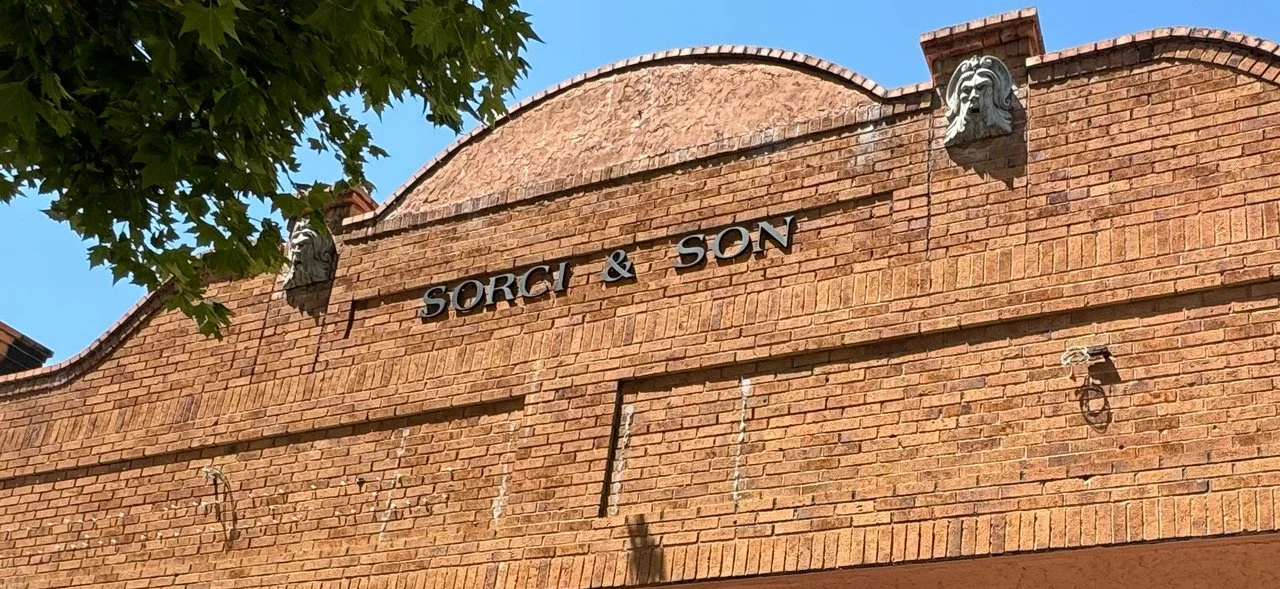
SORCI & SON
This Mediterranean Revival commercial building was built by local Gilroy builder William Radtke in 1920. This structure is a stylistic version of the brick front commercial design. While retaining original design elements, the store fronts have recessed entrances that were modified using aluminum frames with large glass panel doors. From the middle of the wall upward and outward, the facade is original in design. The brick is set to show a skeleton of structure with recessed panels for signage. The curvilinear cornice is decorated with four molded shields and semi-circular crowns. These may have been added after original construction.
This building is historically and architecturally significant due to its being a slightly more ornate version of the standard commercial building design which lines Monterey Street. This structure is notable particularly in the handsome brickwork and distinctive curvilinear cornice line (in the manner of an Espadana or bell gable). Plaster decorative shields further define the four squared parapets (wall projection above the roof) which punctuate the street façade adding visual rhythm. The other features of the building repeat the spatial breakup which characterizes the commercial storefronts’ aluminum framing that has been added to the façade entry. Although this too is a supporting structure, it provides a significant function in bridging the gap between the half dozen or so major buildings in downtown Gilroy and the small strips of commercial structures between the larger buildings.
Occupants have included a variety of businesses throughout the years.
7578-88 Monterey Street
(1921)
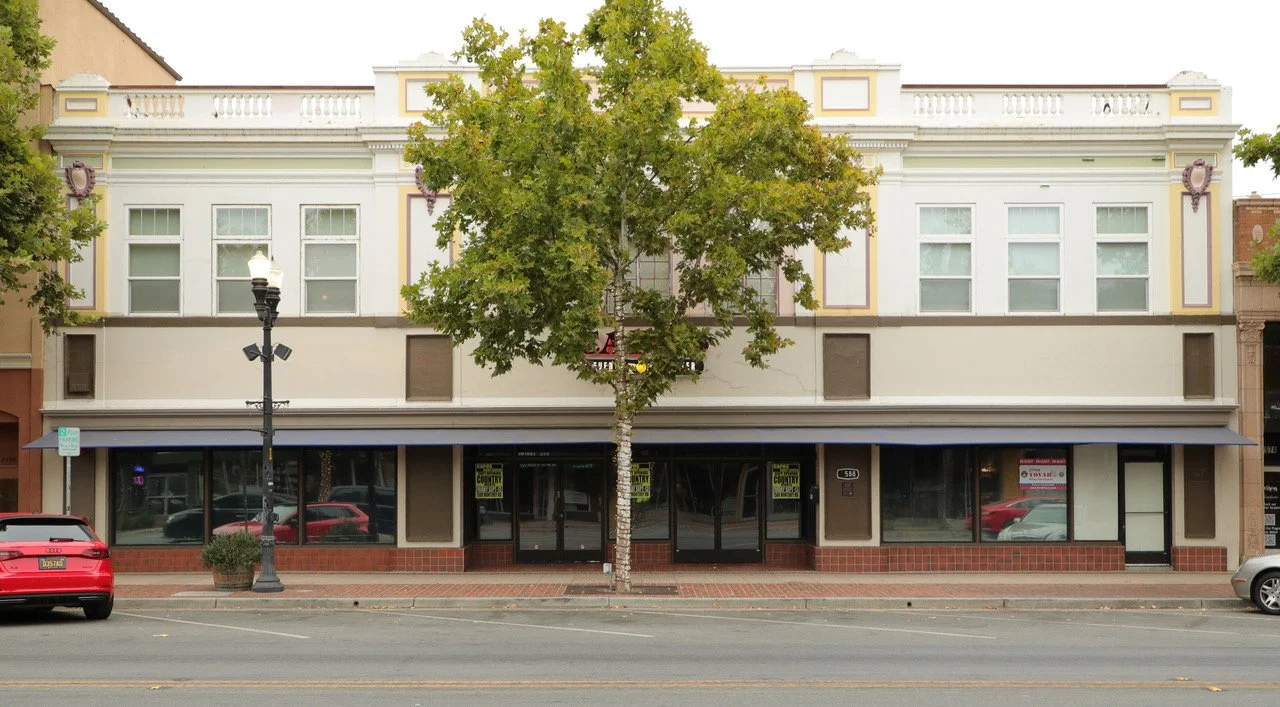
STRAND THEATER
The Strand Theater was built in 1921. This two-story Neoclassical formed reinforced concrete building was erected as an extension of the Masonic Lodge previously located next door to the north. Although the Strand was separate from the Masonic Hall next door, the second floors of the two buildings were connected. Masonic Lodge members used the second story of the Strand as a social hall. Unfortunately, the Masonic Lodge and auto parts store below it (designed by William Weeks) burned down in 1991.
The Strand has many features in common with the former Lodge including flourishes such as a cornice with decorated frieze and windows with circular dividers. Unique to the building is the parapet roofline with spindled baluster railing on top. There was previously a large, art deco marque but unfortunately, it was removed by the owner in the 1990’s. The original center entrance was recessed with a ticket booth in the center. The building helps anchor the best commercial block in the city. Although only in satisfactory condition, the quality of the original design shines through on this building, as it does on a half dozen others on the surrounding blocks of Monterey Street, to give the city a genuine sense of time and place – a rare commodity amid the sprawl of Santa Clara County.
The audience at the new theater could sit in one of 900 plush opera seats and listen to the $15,000 pipe organ. Stars appearing in live productions used one of the four dressing rooms at stage level. Lesser performers had dressing facilities available in the basement. Performances at the Strand included local and professional theater productions, concerts, musicals, and Gilroy High School theater presentations. The Strand also presented current Hollywood movies through the 1980’s. In the early days admission was ten cents for children and twenty cents for adults. Next door was a popular ice cream shop – Schillings.
Architectural and Historical Significance includes the fact that the Strand Theater, when it was completed and opened on December 3, 1921, was the most elegant entertainment center in the area. The architects who drew up the plans were the Reid Brothers of San Francisco. William Radtke, a well-known local builder, was the contractor. The builders expressed pride that the theater was modern in every way due to the reinforced concrete. Radtke learned how to use this technique when he contracted with Henry Miller, largest landowner in the area, to construct the concrete silos that are still standing east of Highway 101, between the highway and the railroad tracks, just south of the ramp to Highway 25.
Current occupants use the facility as a night club and dance hall featuring popular local musical groups.
7568-74 Monterey Street
(1928)
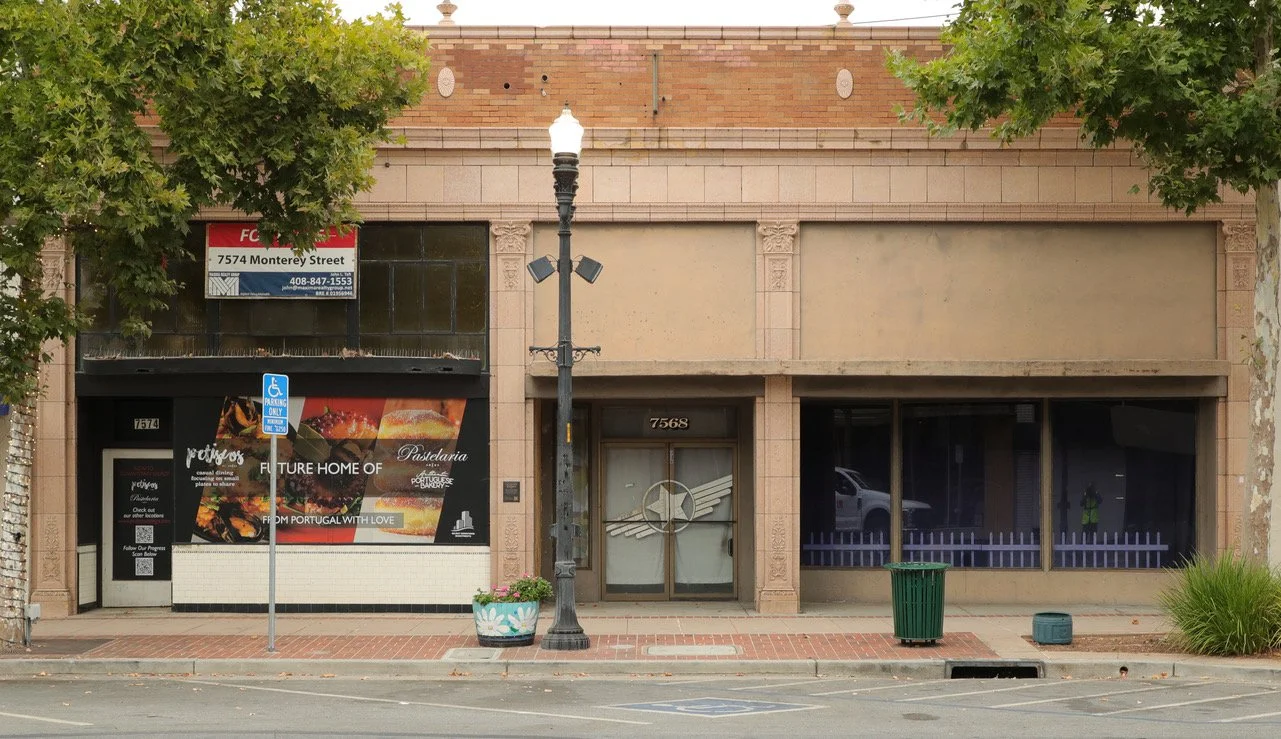
CHALOUPKA BUILDING
This two-story Neoclassical brick front commercial building was constructed in 1928 by local contractor William Radtke. Its first tenants were Floyd Dickson’s Chevrolet Garage and the Chaloupka family’s Golden Poppy Bakery (located at the 7574 address in the same building). The Chaloupka family operated their business in this building until 1964. Several other bakeries (Johnson’s Pastry Shop, Coulston’s Bakery, Taste Rite Bake Shop, and El Camino Bakery) operated in the same location after the Golden Poppy Bakery closed.
The family patriarch Joseph Chaloupka, a native of Czechoslovakia, came to Gilroy in 1922 with his wife Kamila and was an active member of the community for more than 50 years. He was a trustee of Wheeler Hospital for 35 years, a charter member of the Gilroy Elks Lodge, and past president and member of the Gilroy Rotary Club since 1925. He passed away in 1976 at the age of 83.
In 1930, Dickson’s garage in the 7568 portion of the building was replaced by a grocery store called the Red & White Gilroy Food Shoppe, an independently owned and operated chain store associated with the Red & White Corporation. Started in 1925 and headquartered in Chicago, Illinois, the firm provided centralized buying and distribution for small town stores to allow them to compete against the large chains that were consolidating their power in the 1920s. All members of this group had the words Red & White as part of their names, usually with the owner's name or town name as well. Its signature red dot logo with the words Red & White (see below) appeared on all of their food products and can still be found on small independent grocers in the U. S. and Canada.
After the Red & White store left in the mid-1930s, the building was leased to a variety of tenants including a series of beauty/dress shops (Yvonne & Marion’s Beauty & Dress Shop, Marion’s Dress Shop, The Smart Shop) (1936 - 1953), some sewing/drapery businesses (Singer Sewing Center, Rasmussen’s Drapery Shop) (1954 - 1959), and a Western Union and equipment sales office (1960 - 1975).
The 7568 portion of the building is currently vacant and open for commercial lease. However, it appears that the 7574 portion of the building is returning to its roots as a Portuguese bakery (Pastelaria) plans to occupy the space.
7560-62 Monterey Street
(1931)
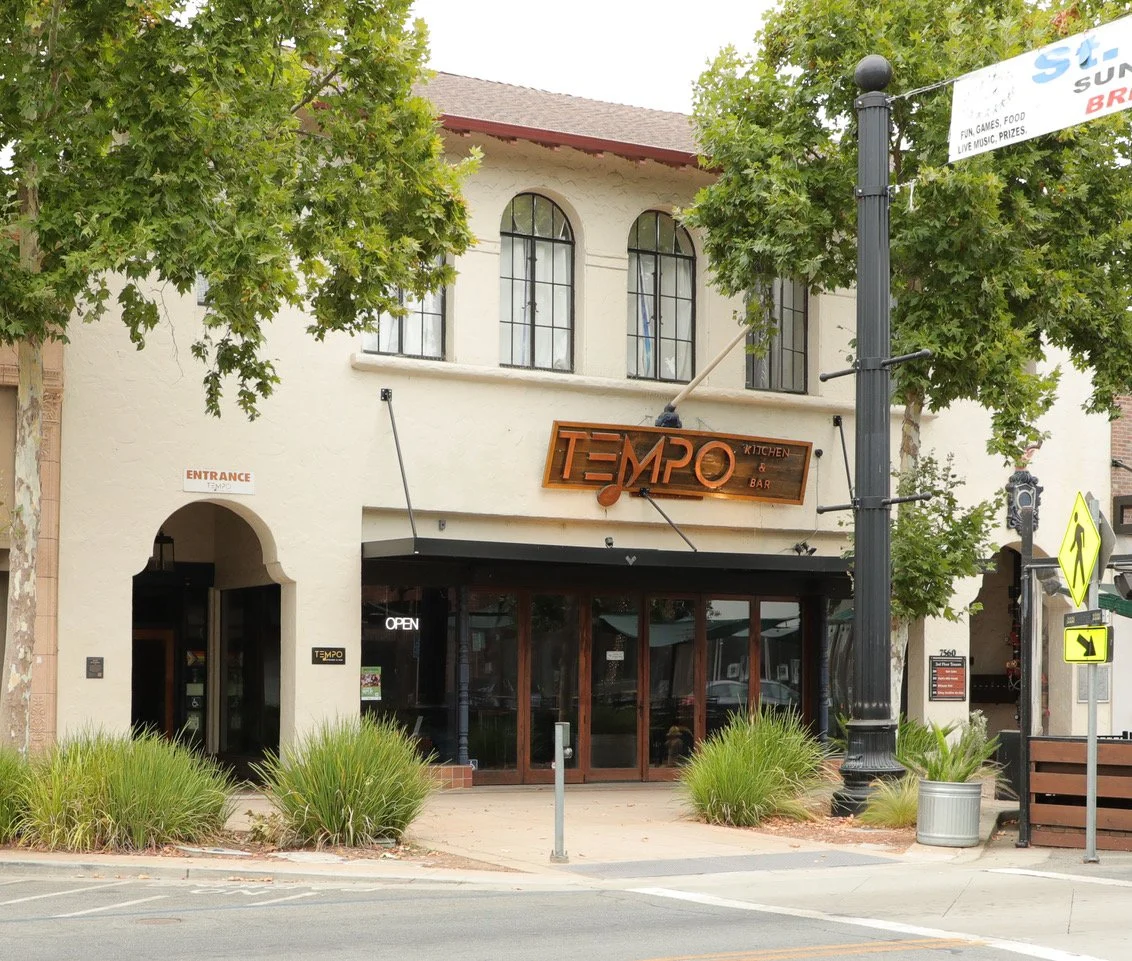
ELKS BUILDING
This two-story Spanish colonial revival building, formerly known as the “Elks Building,” was designed by architect Albert Roller and built by William Radtke in 1931 for the Gilroy Elks Lodge. The original arched windows along the top of the façade and double ornate wooden posts by the entrance remain intact. Over the arched doorway outside, you can see an elk’s head with a shield above the arched upstairs entrance (see photograph below). A framed marble plaque commemorates the building as a gift from Lin W. Wheeler, owner of Pieters-Wheeler Seed Company, to his Elks brothers of Gilroy Lodge #1567. Because the original building was made from poured concrete, it is one of a few commercial buildings in Gilroy that did not need to be retrofitted when recent laws made that a requirement for older structures built from brick.
In addition to being an original founder of the Gilroy Elks Lodge, Lin Wheeler was one of the most prominent residents and philanthropists in the history of Gilroy. He came to Gilroy in 1910 from New York state and owned the aforementioned seed company, which served the rapidly expanding agricultural businesses in the Santa Clara Valley. Wheeler’s philanthropy led to the construction of Wheeler Hospital, the city’s first major medical facility, in 1929, Wheeler Auditorium, still used for civic events and entertainments today, in 1940, and the city’s Gymkhana Grounds, where Gilroy’s legendary annual Gymkhana rodeo event was held from 1930 through 1956.
While the Elks conducted their meetings upstairs, the downstairs housed several furniture stores, including Barshinger’s. In 1969, the Gilroy Elks relocated to their current location on Hecker Pass Highway just west of Gilroy, a facility built with the proceeds of the sale of their building on Monterey Street. In 1979, the building was purchased by Ford’s Department Stores, which was the oldest department store chain in California at the time. Changing retail shopping trends and extensive damages to Santa Cruz and Watsonville Ford stores caused by the 1989 Loma Prieta earthquake eventually forced Ford’s to declare bankruptcy in 1993 which led to the closure of the Gilroy store location.
In January 2018, the building became the home of the Golden State Brewery which heralded a microbrewery expansion for downtown Gilroy with signature outdoor seating area along Monterey Street. The brew pub and grill closed in September 2019 and was eventually replaced in November 2021 by the current tenant Tempo Kitchen and Bar, an open-air restaurant and bar hosting live music acts and other themed events.
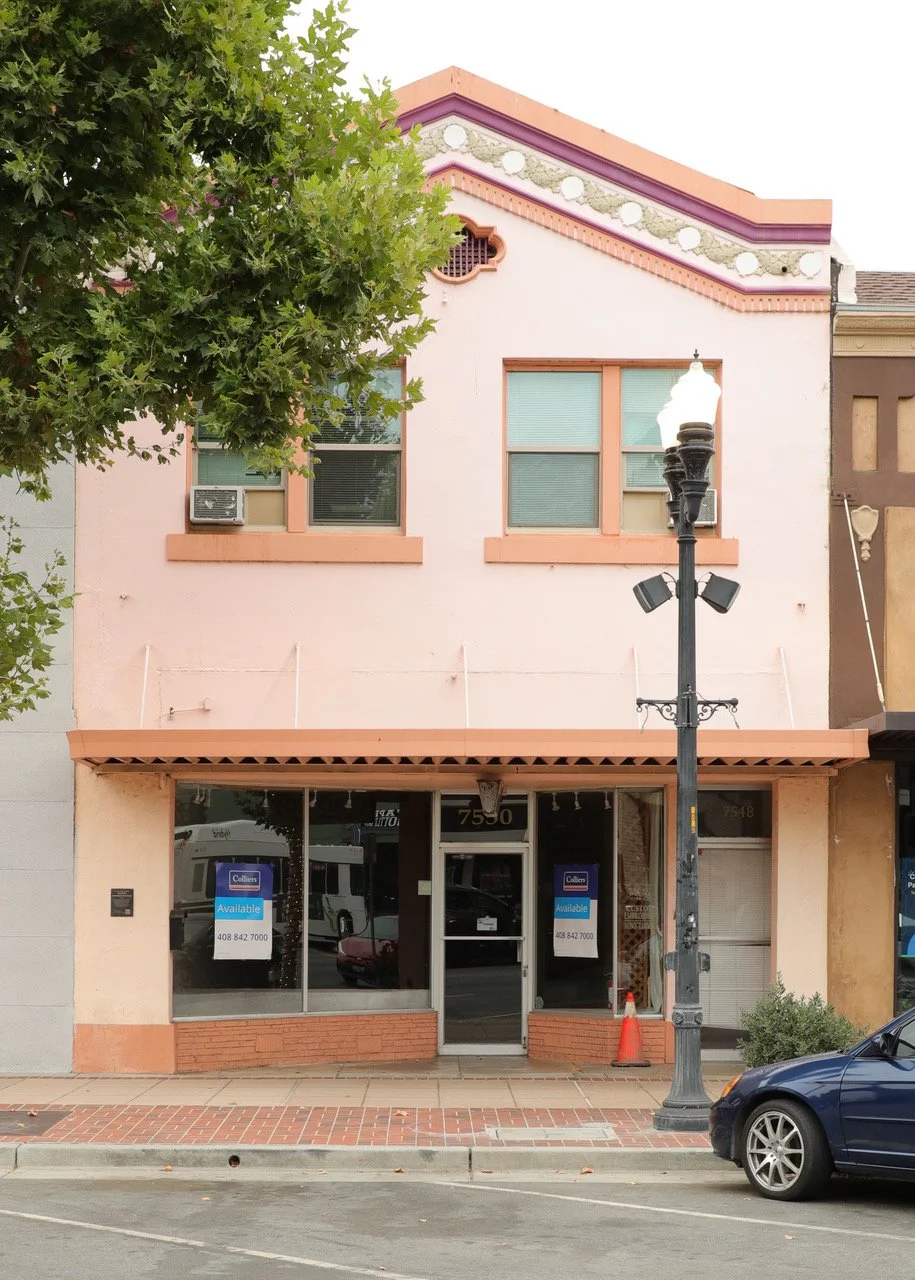
7550 Monterey Street
(1919)
GILROY RUBBER WORKS
This two-story Spanish Colonial Revival building was constructed in 1919 by local contractor William Radtke as the home of the Gilroy Rubber Works, which manufactured, repaired and sold tires at this location until 1951. Shortly after its opening in 1919, the Gilroy Rubber Works, advertising itself as the “The Tire House of Gilroy”, published some rather colorful sales pitches in the Gilroy Advocate, the city’s primary local newspaper at that time.
One from 1920 read, “ ‘My hat’s off to you, as experts in vulcanizing (the term used to describe tire repair or production then)’, said one of our patrons. ‘You have saved me the cost of two or more new tires this season by making the old ones as good as new.’ We will do the same for you. Don’t willfully wear your tires out, bring them here before they are entirely done for. A stitch in time saves nine and we will make your tires last indefinitely if you have them vulcanized at Gilroy Rubber Works, Baxter & Maggini, Props..”
Another read, “We can do more to make an old tire new than you would think was possible, by our up-to date vulcanizing methods and your tires are practically as good as new at a small outlay. Our work is A-1 and we are prompt and obliging at all times. If you need new tires or accessories, you will find them at Gilroy Rubber Works.”
From these advertisements, one gets a sense of how rugged driving an old Model-T on the roads of small towns like Gilroy and Santa Clara County must have been. Having a local tire repair facility or auto repair garage available was an absolute necessity. With all the noise and repair activity happening on the first floor of the building, it’s hard to countenance that a beauty salon, Doane’s Beauty Shoppe, conducted business on the second floor of the building during its early days.
After 1951, the building had a variety of tenants including a photography studio (Battaglia’s Photography Studio) (1957 - 1960), the Gilroy Judicial District offices (1960 - 1964), a flower shop (Gilroy Flower Shop) (1964 - 1971), a gift shop and a Mode-O-Day Dress Shop (1971 - 1976).
The building was most recently home to the Garlic City Embroidery Studio, which provided customized embroidery services. An equipment store for equestrians called Saddles & Treasures is scheduled to occupy the space in the near future.
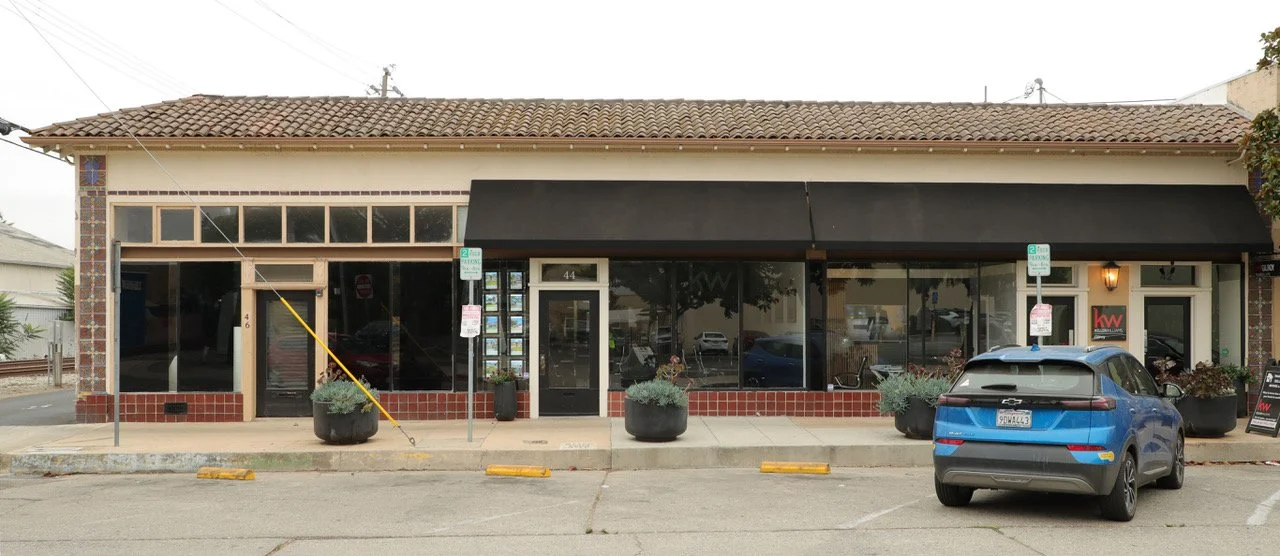
40-46 Martin Street
(1929)
RADTKE BUILDING
This one and a half story Spanish Revival style commercial building, built in 1929 by William Radtke, served as the home office of Radtke Construction, one of the most prominent and prolific construction companies in Gilroy and the Central Coast during the 20th century. With a career spanning the years 1906 to 1969, William Radtke greatly influenced the entire area of Central California with his buildings.
Born in San Francisco in 1888 to German immigrant parents August and Adelheid Radtke, William moved with his family to the San Jose area where he was educated at the Hamilton Grammar School. After serving apprenticeships with machinist and carpentry firms in the San Jose/Santa Clara areas, Radtke formed his own construction business in 1906 at the age of 18. Among his first efforts were the construction of the Los Altos Grammar School and the Guadalupe Creek Bridge. Radtke’s first project in Gilroy was the building of three concrete silos in 1911 on the 13,000-acre Bloomfield Ranch of pioneer cattle rancher Henry Miller (another German immigrant), which still stand to this day just east of Highway 101.
Understanding the potential of the Gilroy area, Radtke and his wife Clara moved to the town in 1912. His first contracts in Gilroy were the building of the Llagas Creek Bridge and the First National Bank Building on the corner of Monterey and Martin Streets in 1912. In 1913, his firm constructed an 8.5-million gallon reservoir for the Gilroy Water Department. Other major projects were Gilroy’s first standalone Fire Station in 1916, the Drake Apartment Building in 1919, the Masonic Building, the Louis Hotel, and the Strand Theater, all in 1921, the F. W. Woolworth Building and Barshinger’s Mortuary (now Habing’s) in 1928, Wheeler Hospital in 1929, and the Elks Building in 1931. In the 1920s and early 1930s, Radtke Construction essentially rebuilt most of the major buildings in downtown Gilroy.
Buildings built by Radtke in later years included the Veterans Building on the corner of Sixth and Eigleberry Streets and the Post Office on Third Street in 1951, the Salinas Valley Savings and Loan Building on Monterey Street in 1960, and the Masonic Temple on Wren Avenue in 1964. In addition to his larger projects, Radtke’s company constructed the houses of many area residents often working with the prominent local architect William Weeks. Despite a busy construction schedule, Radtke found time to serve Gilroy, putting in two terms on the city council from 1927 to 1931. After a lengthy illness, William Radtke passed away at the age of 80 on January 29, 1969.
Ownership of Radtke’s office building passed along to his son Thomas Radtke, who owned and operated his own concrete and building supply company in Gilroy until selling his business in 1963. After leaving the construction business, Thomas taught for a number of years at Brownell School before passing away at 61 in 1981 after a short illness. The building on Martin Street housed a number of stores and businesses after the Radtke family sold it and is currently owned by a Keller-Williams Realty brokerage.
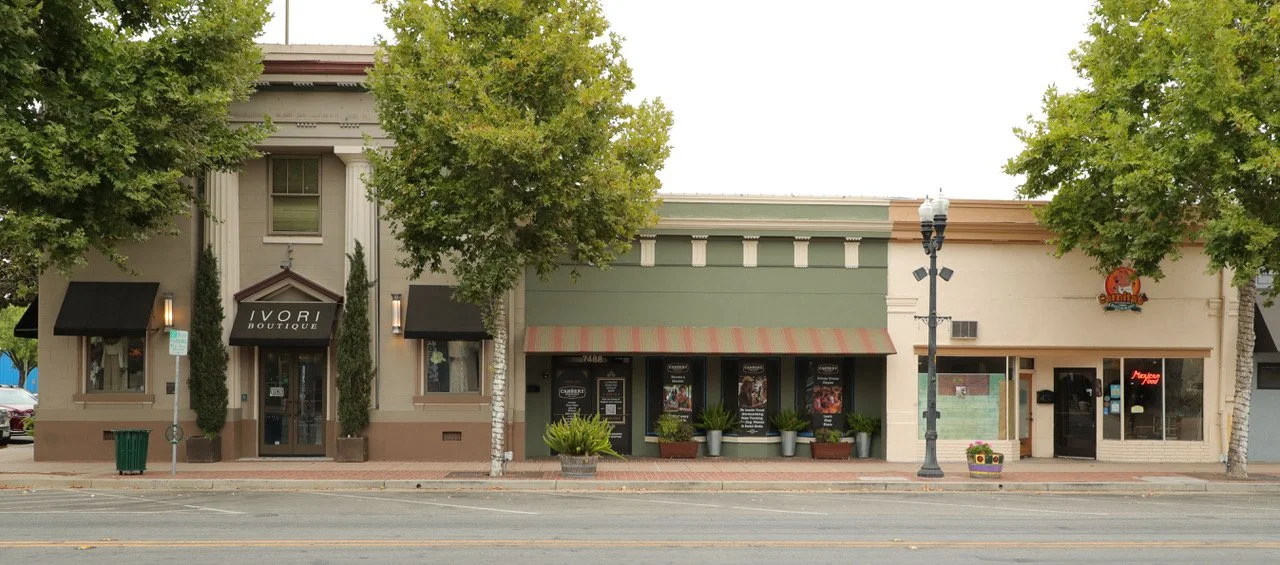
7484-90 Monterey Street (1912)
HERSMAN BUILDING
This two-story Classical Revival style building was constructed in 1912 by local contractor William Radtke as the home of the First National Bank of Gilroy, the second bank established in the city after the Bank of Gilroy in 1871 (which eventually became the Bank of America). The bank was organized by the Mercantile Trust Company headed by Hugh Steele Johnson who served as the bank’s first president. Hugh Johnson was succeeded by Hugh S. Hersman, who served as president from 1914 to 1918. The building is often referred to as the Hersman Building as Mr. Hersman was a very prominent banker, businessman, and politician in Gilroy and the Bay Area having served as an officer and director of various corporations and as an elected Representative to Congress from California from 1919 to 1921.
Various banking institutions resided on this corner after the First National Bank including the Mercantile Trust Company of California in the mid-1920s and the American Trust Company, its primary tenant from 1929 through 1953. Afterward, the bank portion of the building became the law offices of attorney Sidney Johnson.
The building also contains several one-story storefronts on both Monterey and Martin Streets. The building housed the Gilroy Shoe Repair Shop (1959 - 1966) and Kirby’s Appliance and Television store from 1953 well into the 1970s. The building is currently home to the Ivori Boutique and The Cannery gift shop.
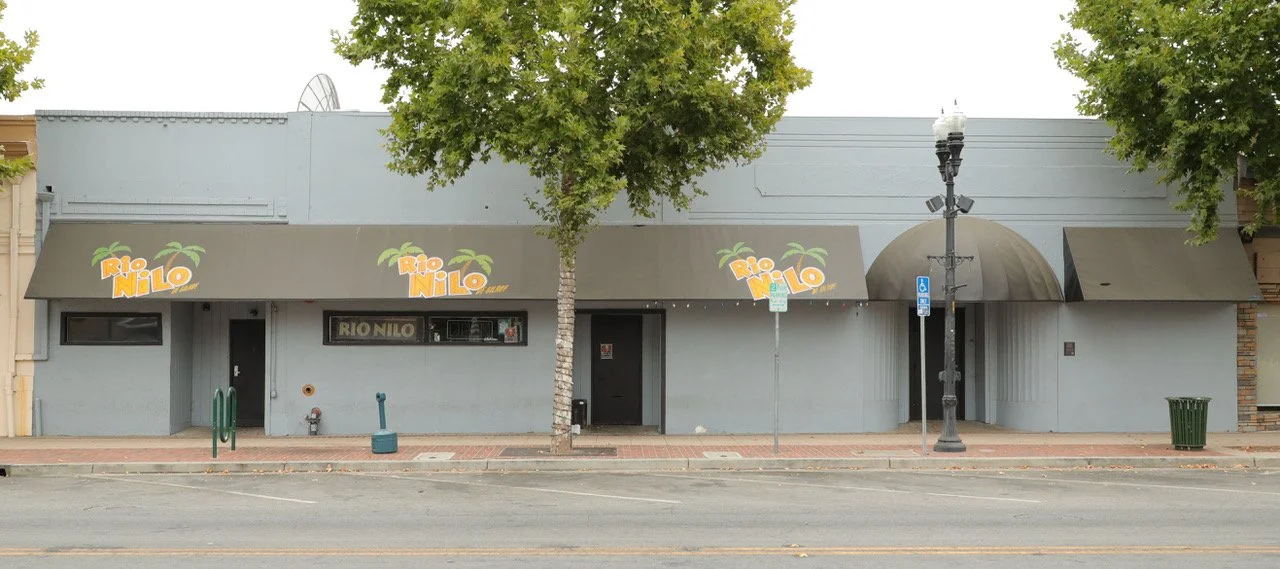
7466-82 Monterey Street
(1917)
DISPATCH BUILDING
This large rectangular Moderne style commercial building constructed in 1917 by William Radtke is best known as the home of the Gilroy Dispatch newspaper offices from 1945 to 1981. The street front of the building is plastered over, with bands of incised straight lines and a slightly raised panel providing the only major architectural embellishment on the facade. Its Moderne style is further emphasized by the entry which has a dome-shaped metal canopy with recessed double doors surrounded by fluted, curved walls. The adjacent sections of the building are similarly plastered and whitewashed with all ornament removed except for the harsh geometrical pattern of simple apertures. It represents the more standard commercial style building type found in central Gilroy. Currently home to the Rio Nilo Club (a night club and Mexican restaurant established in 1997), the building street front has been repainted and sun shades have been added to the windows and entry door as shown in the photo above.
Prior to moving their staff, typesetters, and printing presses to the Dispatch Building at 7466 Monterey Street the Dispatch offices were located in a smaller building one block south at 7360 Monterey Street from 1926 through 1945. The Dispatch replaced Miller’s and Keefe’s Variety Stores which had occupied the 7466 Monterey of the building for many years.
Originally known as the Gilroy Evening Dispatch (before becoming the Gilroy Dispatch in 1962), the Dispatch was started by John Hall and Thomas Losey as a six-day daily newspaper in 1925. In 1930, Lloyd E. Smith completed his purchase of Hall and Losey’s shares in the paper and in 1933, bought the Gilroy Advocate from William F. Blake. The Gilroy Advocate, a weekly paper published by Blake’s father F. W. Blake and others before him, had been Gilroy’s primary news publication since 1868. Smith continued the Advocate’s weekly publication, but eventually sold the Dispatch and the Advocate to The Gilroy Publishing Company owned by Anderson Browne and James Marmaduke in 1939.
In 1941, William G. Werner bought the Dispatch and the Advocate, then sold them to Joseph Houghteling, George Kane, and Patrick Peabody in 1949 who ended publication of the Advocate that year. The trio sold the Dispatch to Jerry Fuchs and Millard Hoyle in 1972. Its tenure as an independent news organization ended when it was acquired by the McClatchy Newspapers, Inc., a media conglomerate in 1978.
In 1981, the Dispatch offices were relocated to a new building further south at 6400 Monterey Street. Since then the Dispatch was purchased three more times (1997, 2004, and 2014) by large media companies. The current owner is New SV Media, Inc., a subsidiary of Metro Newspapers of San Jose, California. After decades in the building on south Monterey, the Dispatch returned to downtown Gilroy in 2016, moving its offices to 64 West Sixth Street. In 2020, the Dispatch’s owner purchased a 2,400 square foot building at 7455 Monterey Street and moved its offices to its current location in the rear of the building along Gourmet Alley. The publisher Dan Pulcrano believes the investment will add to the recent revitalization effort by downtown property owners to upgrade the alley with new restaurants and other businesses.
Today the old Dispatch building is fully occupied by the Rio Nilo Club, but for many years the north end of the structure had several different addresses (7474, 7478, 7480, 7482) that housed a variety of retail establishments. The first store was James Muckle’s Plumbing shop (1926 - 1930), followed by four different beauty salons/barbershops (1936 - 1955), a Farmer’s Insurance office (1955 - 1965), and a self-service laundry, photography shop, and shoe store in the late 1960s and early 1970s.
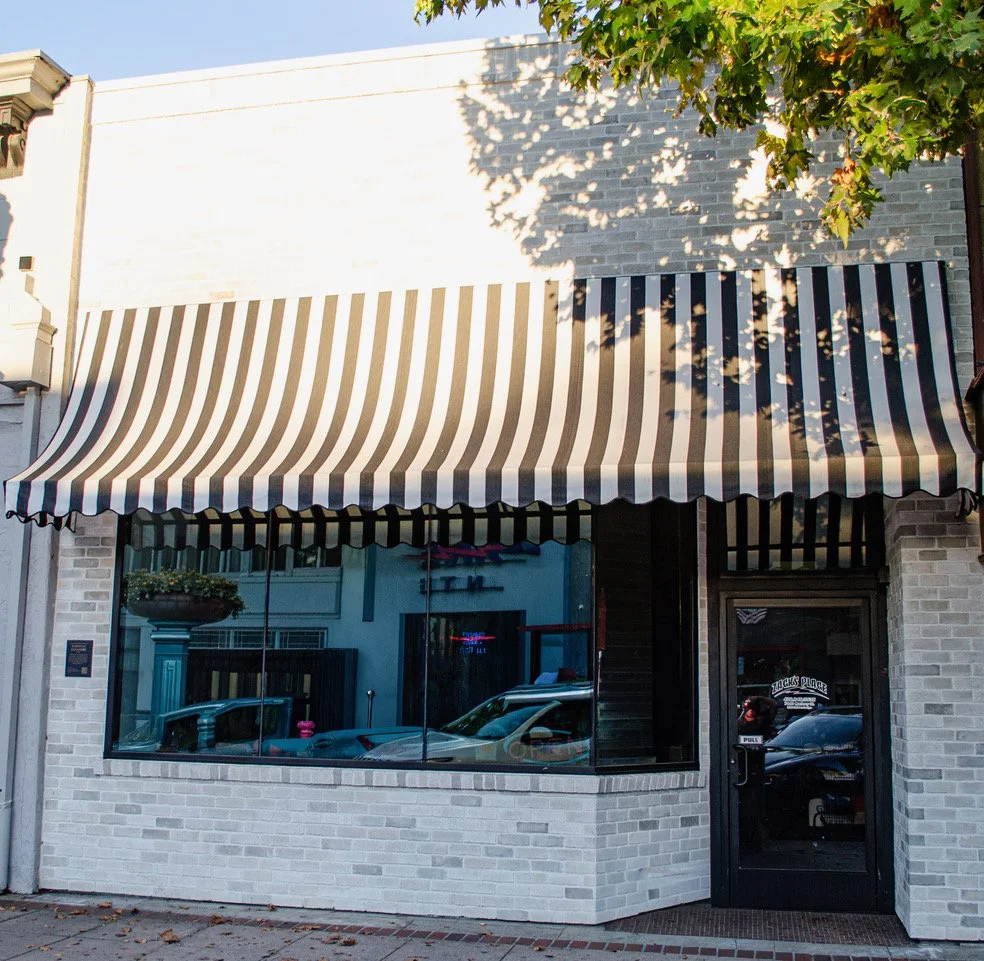
7440 Monterey Street
(1910/21)
PARISIAN CLEANERS
The historic Parisian Cleaners Building was constructed circa 1910 and later modified around 1921 by an unknown builder and architect, according to historical and architectural surveys by the city. The building is a classic example of the Moderne architectural style which was popular from the early-to-mid 20th century. The structure is a simple rectangular planned building with distinctive tile sheathing covering the façade and a very large oversized canvas awning covering a majority of the storefront. Aluminum framed doors and windows of large plate glass highlight the front display areas. The single-story building is actually lower than the adjacent neighbors, however the oversized awning is used both as a sign and as a way to bring the shorter building into visual alignment with its taller neighbors.
The building served the Gilroy community as a dry-cleaning facility and was part of a bustling group of downtown Gilroy businesses. Named Parisian Cleaners, the business introduced the “Parisian cleaning method”, a new form of commercial dry-cleaning, to local residents. The term Parisian cleaning originated in the mid-19th century in France when Jean Baptiste Jolly, a French dye-house operator, accidently spilled kerosene from a lamp onto a stained tablecloth. To his amazement, when the kerosene evaporated, the fabric was completely cleaned. Mr. Jolly went on to open the world’s first commercial dry-cleaning establishment in Paris circa 1855, declaring his non-water process as dry- cleaning.
Local historical records are scarce concerning early operators of the business; however, mid-century archives highlight the patriarch and matriarch of the Camborde family as owners of the business starting circa 1921 and during its mid-century heyday in the 1950s. Historic city records from the early years list Leanie Camborde as operator of the laundry/cleaner service. The family also owned another iconic Gilroy mainstay, The Willows Restaurant and Bar.
Local Japanese-American community archives document the Ishihara family taking over operation of the dry-cleaning business about 1962. Maki Ishihara is the family member associated with the operation and ownership of the business. According to property data and historical records, the location maintained continuous use as a dry-cleaner into the turn of the century. At that point a new business license for a retail apparel and screen
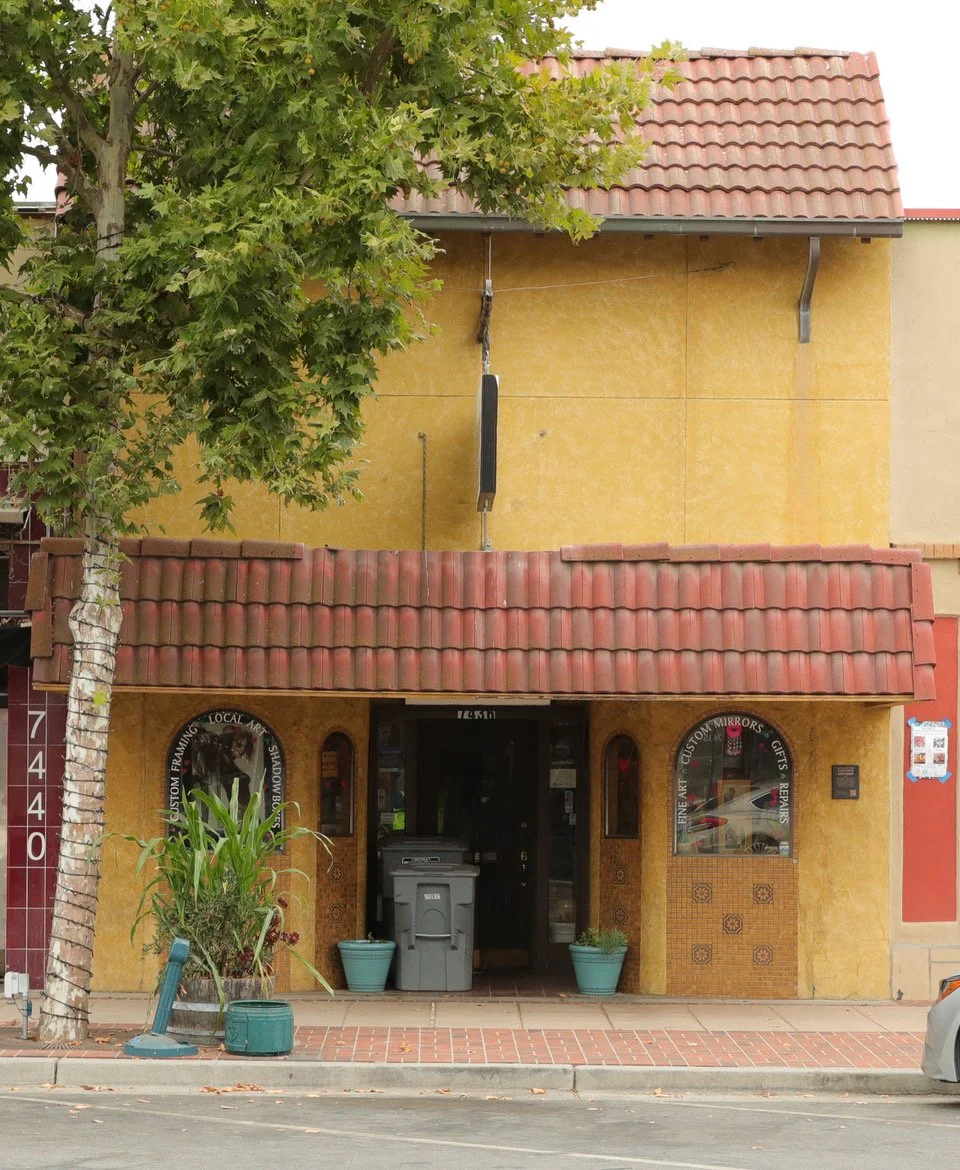
7436 Monterey Street
(1912/1925)
LAWTON’S GEM SHOP
This narrow rectangular, single story, commercial building was built in 1912 by William Radtke for the Coast Counties Gas and Electric Company. Originally designed in a stripped commercial style, it has been greatly altered by adding pseudo-Spanish detailing from the 1960 - 70s. For many years, the most intriguing feature of the building was a round projecting clock above the red tile entry roof advertising Lawton’s Gem Shop, one of Gilroy’s oldest family-owned businesses which operated there from 1956 to 1991. The clock has since been replaced by a placard identifying the current occupant - Leedo Art & Framing.
In an October 1926 issue of the Gilroy Evening Dispatch, a Coast Counties Gas and Electric Company advertisement celebrated the company’s 60th year of business. The ad states that the company began as a small gas manufacturing plant in Santa Cruz in 1866 which “has now grown until it serves nearly 24,000 gas and electric consumers in five of California’s richest counties. This growth has been inseparably interwoven with the development of the communities served. By the most natural process, the Coast Counties Gas and Electric Company has become truly a public institution. More than 2700 “joint” owners - mostly small stockholders - receive dividends regularly. To widespread stockholder ownership is added public control, through the State Railroad Commission. Entire communities properly share our satisfaction in this progressive chapter of California history.”
The Coast Counties Gas and Electric Company was one of several regional gas and electric companies overseen by the California Railroad Commission which was initially created in 1911 to curb the monopolistic practices of powerful railroad corporations. In 1912, California enacted the Public Utilities Act to expand the Railroad Commission’s authority to include natural gas, electric, and telephone companies to ensure these public service companies charged fair rates and services to consumers, reflecting a growing recognition of the importance of these utilities in everyday life. In 1946, the Commission was renamed the California Public Utilities Commission (CPUC), which continues to regulate the activities of public utility companies today.
Throughout the first half of the 20th century, the Coast Counties branch office located in this small space on Monterey Street served the growing gas and electric power needs of the Gilroy community. In 1912, the Coast Counties Gas and Electric Company established its presence in Gilroy when the Coast Counties Light and Power Company acquired the Gilroy Gas Works Company. In the 1920s and 30s, the company aggressively pursued new customers by continuously promoting the affordability and efficiency of its clean natural gas and electrical services to convince local residents to convert from antiquated methods of heating (coal/wood burning furnaces and stoves) their homes and businesses. It offered installation of modern water heaters at special introductory prices and easy payment plans and provided gift certificates toward the purchase of brand name appliances (General Electric washers, refrigerators, radios, mixers, toasters, irons, vacuum cleaners, etc) at local hardware stores. The convenience of having “ALL the hot water you want, day or night, just by turning the faucet!” was one of their major selling points.
Gilroy newspapers during this period contained many articles (most likely ghost written by Coast Counties employees) espousing the good works and community benefits provided by the utility - articles touting the annual company dividends earned by local area stockholders, many of modest means; columns containing recipes and humorous anecdotes about husbands actually enjoying cooking, spending more time helping in the kitchen with the advantages of modern appliances and convenience of natural gas and electrical heating. There were articles about the number of neon signs installed in downtown Gilroy by the company making Gilroy one of the “best lighted small cities in California”. Much was made of the gas and electrical service provided to major canneries in town such as the Filice & Perrelli plant, a major employer of local residents at the time. The company district managers were often active in the community as members of the Chamber of Commerce, the Rotary Club, or the Elks Club. The Coast Counties presence in the city sadly ended in 1955 after it was absorbed, like many other small regional utility companies, by the Pacific Gas & Electric (PG&E) Company in 1952. Many Coast Counties employees continued their careers with PG&E.
After Coast Counties departure, the building became the new home of Lawton’s Gem Shop. Owned and operated by George Lawton and Elizabeth “Betty” Lawton, Lawton’s Gem Shop already had a lengthy presence in downtown Gilroy previously residing at 183 N. Monterey Street (7583 Monterey Street today) from 1925 to 1931 and 178 N. Monterey Street (7578 Monterey Street today) from 1932 to 1955. Born in San Francisco in 1890 and raised in the Paicines area south of Hollister where his parents owned and operated a hotel, George served in the Navy during World War I and following the war studied the jewelry business in San Francisco and San Jose. Born in the Bronx, New York, Betty grew up in New Jersey where she later met George on one of his Navy assignments. After their marriage and the birth of their first child, George, Jr., the Lawton’s decided to move to California, purchased a Ford Model T, and in 1922 took a month long drive across country to San Francisco. Eventually they decided to settle down in Gilroy and open their jewelry business as they had become familiar with the small, peaceful town on their many drives from the city to George’s parents home in Hollister. They felt it was a perfect place to raise their growing family of four boys.
Learning the jewelry business from his father including the fine art of ring making, engraving, and gem setting (the shop also sold and repaired clocks and watches, even silverware, eye glasses, and refrigerators), Philip Lawton and his wife Gerry (formerly Hailstone) took over ownership and operation of the shop shortly before George Lawton passed away in 1967. Philip and Gerry continued to employ his mother Betty and several other long time employees until they decided to retire and close the business in 1991. Betty Lawton, the matriarch of the shop, passed away four years later in 1995. Phil Lawton recently passed in 2019.
After Lawton’s Gem Shop closed, the building was briefly occupied by the Gilroy Downtown Development Corporation (GDDC). The GDDC sponsored various civic and artistic groups who used the space for their meetings, book and poetry readings, and musical performances. In the late 1990s and early 2000s, the Gavilan College Small Business Development Center used the space to conduct seminars and workshops on small business entrepreneurship and bookkeeping (oriented toward the Spanish-speaking community).
The building is currently home to Leedo Art & Framing which relocated to the space in 2010 after residing at 315 First Street in Gilroy for 13 years. The owner of Leedo Art & Framing Kimberlee Rossi, having worked for the gallery since 1989, decided to retain the name “Leedo” in the business name due to its familiarity with the Gilroy community. The Leedo Gallery, the name resulting from a merger of original owners Lee and Dorothy Pratt’s first names, had been a well known and successful fixture in the downtown business district at 7529 Monterey Street from 1975 to 1997 before moving to First Street. The Leedo Gallery specialized in signed and numbered prints and lithographs of western wildlife by leading American artists and had an extensive local and nationwide customer base. Ms. Rossi with the assistance of her daughter Sarah has continued some of this trend with framed collectible autographs and posters of sports celebrities like Joe Montana, Magic Johnson, and Tiger Woods, but also displays and offers hundreds of works by local artists in addition to her framing services.
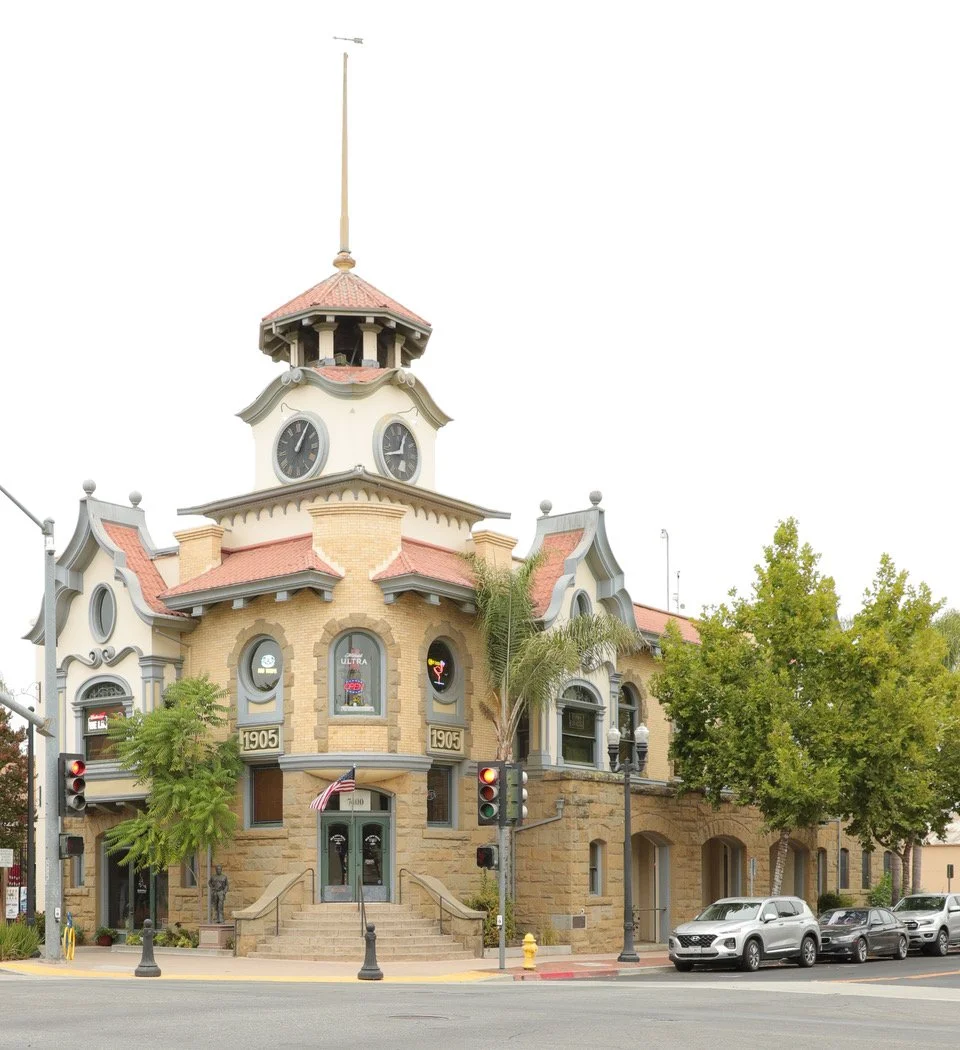
7400 Monterey Street
(1905)
OLD CITY HALL
(National Register of Historic Places)
Built by Granite Construction Company with stone quarried near Christmas Hill Park, this elaborate building was designed by Frank Delos Wolfe. Serving Gilroy’s City Hall for over 50 years, it originally contained all city functions, including the fire and police departments and jail.
More information coming soon…
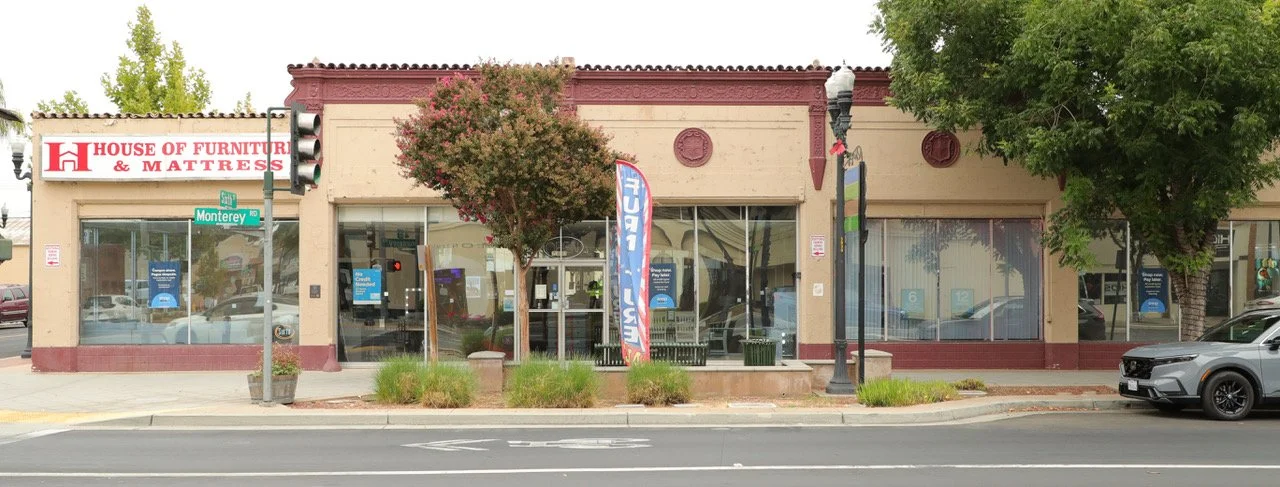
7390 Monterey Street
(1923)
ELLIS GARAGE
The Ellis Garage is a long, single story Spanish Revival style commercial building. The building is rectangular in shape and constructed of reinforced concrete with plaster sheathing. The false front roofing is Spanish tile. A number of decorative floral plaster ornaments adorn the frieze above large plate glass windows along the street façade.
The structure is an extremely handsome example of how easily the 1920s Spanish Revival style of architecture could be adapted for the commercial requirements of main street America. Even though it appears basic with sparse ornamentation, the structure has timeless characteristics that would fit in well with modern Spanish, Mission and Mediterranean architecture.
The building was originally designed to host a new automobile dealership showroom along Monterey Street with substantial vehicle storage in the rear to accommodate both the dealership’s new inventory and provide short term parking for local hotels’ guest vehicles. Both uses generated income for the property owner(s).
History of the Site
Two, new hotels were under construction on the southern end of Monterey Street. One of these was the Milias Hotel across the street. To accommodate the expected demand for guest automobile parking, Annabel Ellis, contracted to expand the existing Highway Garage at the corner of Monterey Street and Sixth Street in the fall of 1921. Unfortunately, during the initial phase of the project, support pillars were removed. As a result, the roof partially collapsed. Mrs. Ellis contacted the local architect, William H. Weeks, to evaluate the damage and determine whether the structure could be saved. It could not and was condemned in March 1922.
Mrs. Ellis subsequently contacted Mr. Weeks in April 1922 to request a quotation for repair of the existing structure. Little change occurred through late July 1922, even though it was announced that Mr. Weeks was in the process of designing renovations that would save the building. While the Gilroy Advocate contains no reporting on the process, the cost to save and renovate the structure likely exceeded the costs of demolition and construction of a new and modern building. In late August or early September 1922, Mrs. Ellis’ daughter, Marion, contracted with Mr. Weeks for the design of and William Radke for construction of the new garage. The existing structure was quickly demolished during September 1922 and construction of the current building began. Construction was completed by Mr. Radke’s company in March 1923 pending Mr. Weeks’ approval.
Tucker Brothers, the local Studebaker auto dealership, was the first tenant, moving in during April 1923. The new garage could accommodate 85 vehicles. In addition to Tucker Brothers inventory, rental spaces were available for use by guests at local hotels. The move by Tucker Brothers made their existing building available. This resulted in a cascade of moves by other downtown Gilroy auto dealerships.
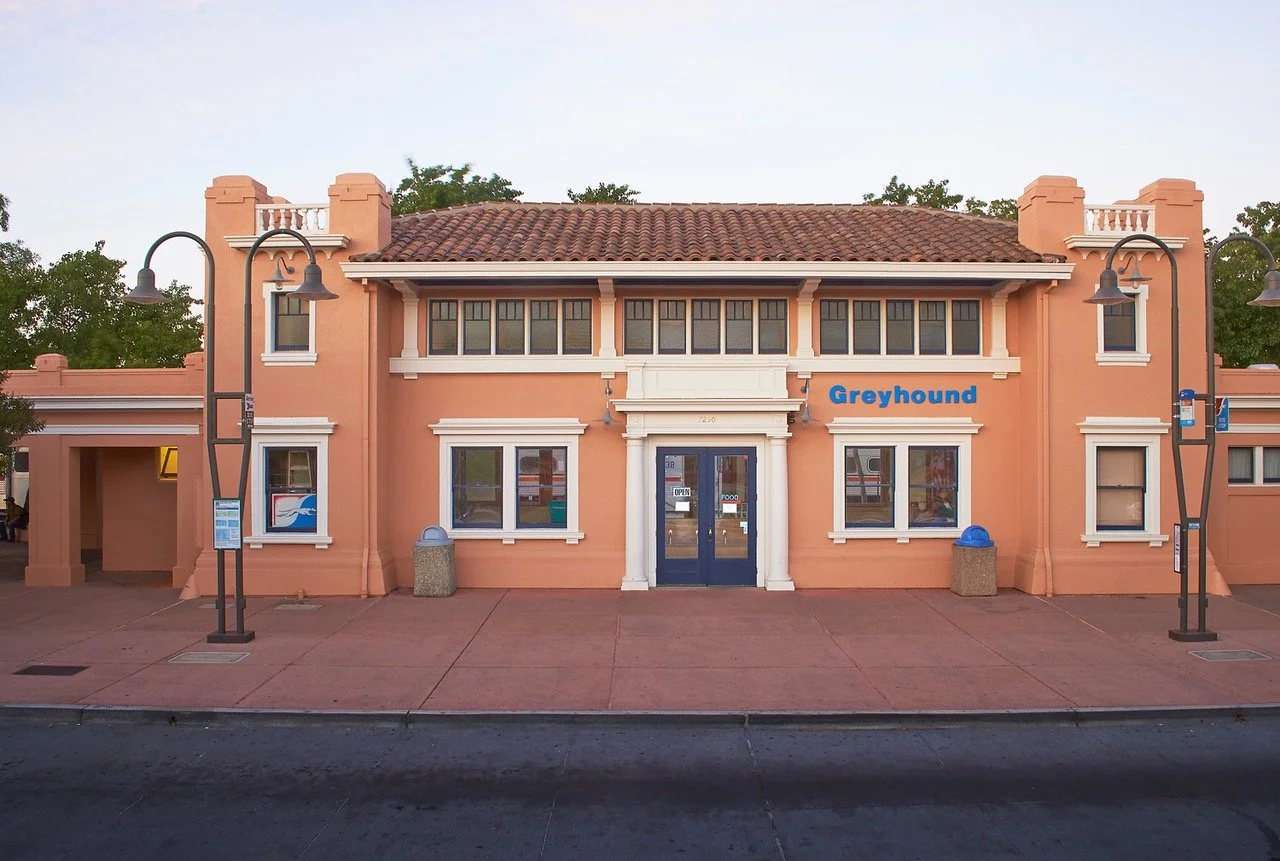
7250 Monterey Street
(1918)
SOUTHERN PACIFIC RAILROAD DEPOT
This two-story Italian Renaissance structure — framed with local redwood and covered in cement plaster — was constructed in 1918 by the Southern Pacific Railroad as a replacement for Gilroy’s first railroad station opened in 1869 by the Santa Clara and Pajaro Valley Railroad. Recognizing the importance of Gilroy as an agricultural and transportation hub, local citizens asked Southern Pacific for a larger station. When this request was ignored they went to Sacramento with the result that the State Railroad Commission ordered Southern Pacific to build this handsome replacement. The building was built for a final cost of $14,000 which translates to roughly $293,000 in today’s dollars (2025). With much fanfare, the Gilroy Railroad Depot was dedicated on April 30, 1918 in a celebration that drew 6,000 people, three brass bands, and reporters from regional newspapers. It was described in local newspapers as offering “spacious waiting rooms” and as the “most beautiful depot between San Francisco and Santa Barbara”.
For the next five decades, the depot served as a way station for rail travelers, but with the advent of super highways and the American public’s love of the automobile, service reductions began in 1929 and the engine house closed in 1934. though the turntable remained in use through the 1950s. The final service to the station was the Del Monte, which ran until April 30, 1971. Amtrak intercity service, including the Coast Starlight, passed through the station without stopping. The depot closed in 1972, and was boarded up with a fence installed around the perimeter.
In the 1980s, a Gilroy citizens’ advisory committee recommended that the Gilroy Railroad Depot and surrounding property become a multi-modal transportation hub which eventually led to Caltrain providing rail service from San Francisco to Gilroy (starting in 1992) and the Santa Clara Valley Transportation Authority (VTA) purchasing the depot site in 1993. After two decades of abandonment, the depot building had sustained significant weather damage and was in dire need of restoration. After aggressive pursuit of government grants by the City of Gilroy and petitions by Gilroy citizens, renovation funds were raised and the building was restored as the centerpiece of the $2.8 million Gilroy Transit Center. In December 1998, the depot re-opened as a transportation hub served by Caltrain, long distance Greyhound buses, VTA buses, Monterey-Salinas Transit, county shuttle buses from San Benito and taxis.
Future plans for the depot call for extended Amtrak Capitol Corridor service, as well as California High-Speed Rail trains, to also stop at Gilroy. In recognition of the depot’s role in and contributions to Gilroy’s formative years, the station was named to the National Register of Historic Places in 2019 as Gilroy Southern Pacific Railroad Depot.
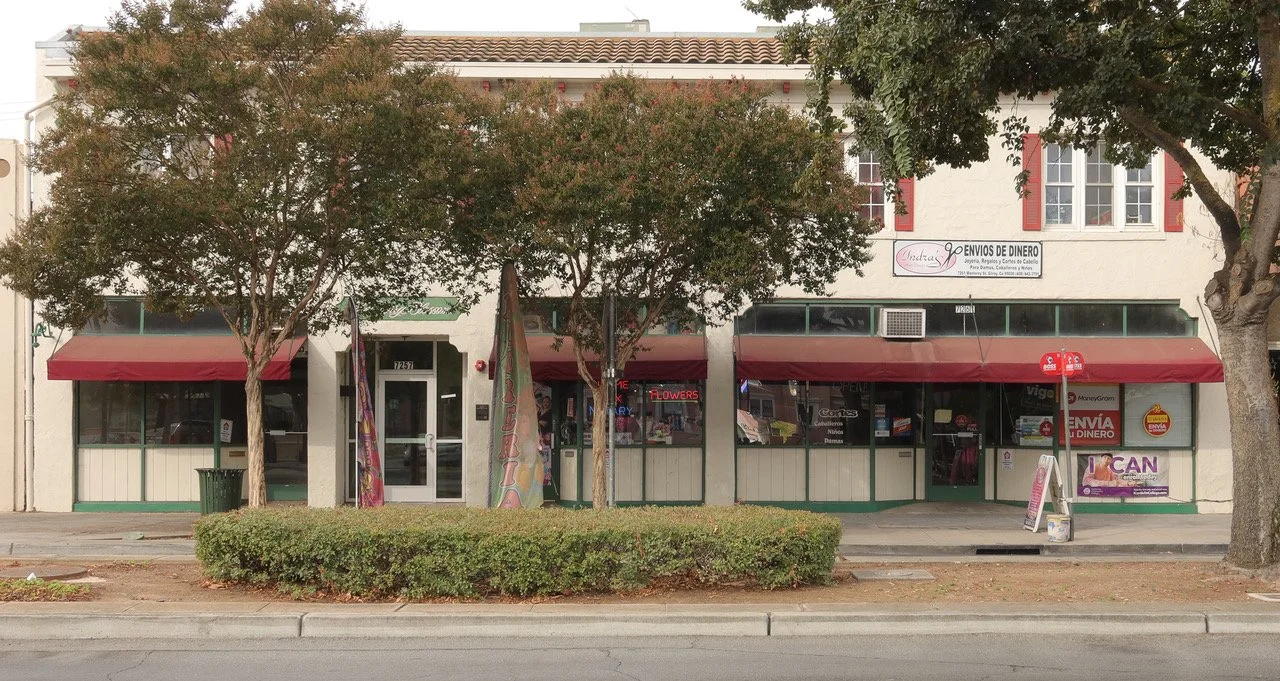
7257-61 Monterey Street
(1921)
CHERRY BLOSSOM HOTEL
This two-story Spanish Colonial Revival structure was constructed in 1921 in a two-block area between Ninth and Seventh Street known for many years as the Chinatown of Gilroy. Chinese immigrant workers (mostly males) settled in this part of town after the completion of the transcontinental railroad in the 1860s. When the city of Gilroy was incorporated in 1870, approximately 1,000 of the city’s 3,000 residents were Chinese, many of whom worked in Gilroy’s then-booming tobacco industry. Across the street from the Cherry Blossom Hotel where the Gilroy Transit Center currently resides was a three-story brick building owned by the Consolidated Tobacco Company, billed as the world’s largest cigar-making factory where as much as 900 of the city’s Chinese residents were employed rolling an estimated one million cigars a month. Owned by Gilroy resident James Culp, this company’s cigars and other tobacco products (protected by a patented curing process) were famous at the time and shipped around the world. Unfortunately, Culp was forced to drastically downsize his business and release many of his workers after the 1879 enactment of a California constitutional amendment prohibiting state corporations from employing Chinese people.
Despite the devastating impact of these laws including the Chinese Exclusion Act of 1882, and the dispersal of many of its Chinese residents to other parts of the state to find work, Gilroy’s Chinatown continued to thrive into the 1920s with a mixture of successful Chinese and Japanese business owners. It boasted restaurants, laundries, gambling dens (and a few opium dens), shops, homes, and boarding rooms. It continued to attract travelers between San Francisco and Los Angeles looking for a little excitement and entertainment. Local tradition holds that the Cherry Blossom was known to be a popular brothel located in the heart of Chinatown.
In 1930, all of Gilroy’s Chinatown, with the exception of the Cherry Blossom Hotel and two other non-wooden buildings, burned to the ground. These three surviving buildings are still standing today. Although the lifestyle and architecture of Chinatown are long gone, many mementos from its past remain. During renovation of the Cherry Blossom building (now owned by the City of Gilroy) in 2004, its owner uncovered many well-preserved artifacts from Chinatown’s storied past, among the items were ceramic and mother of pearl vases, porcelain figurines and old bottles dating back to the late 1800s.
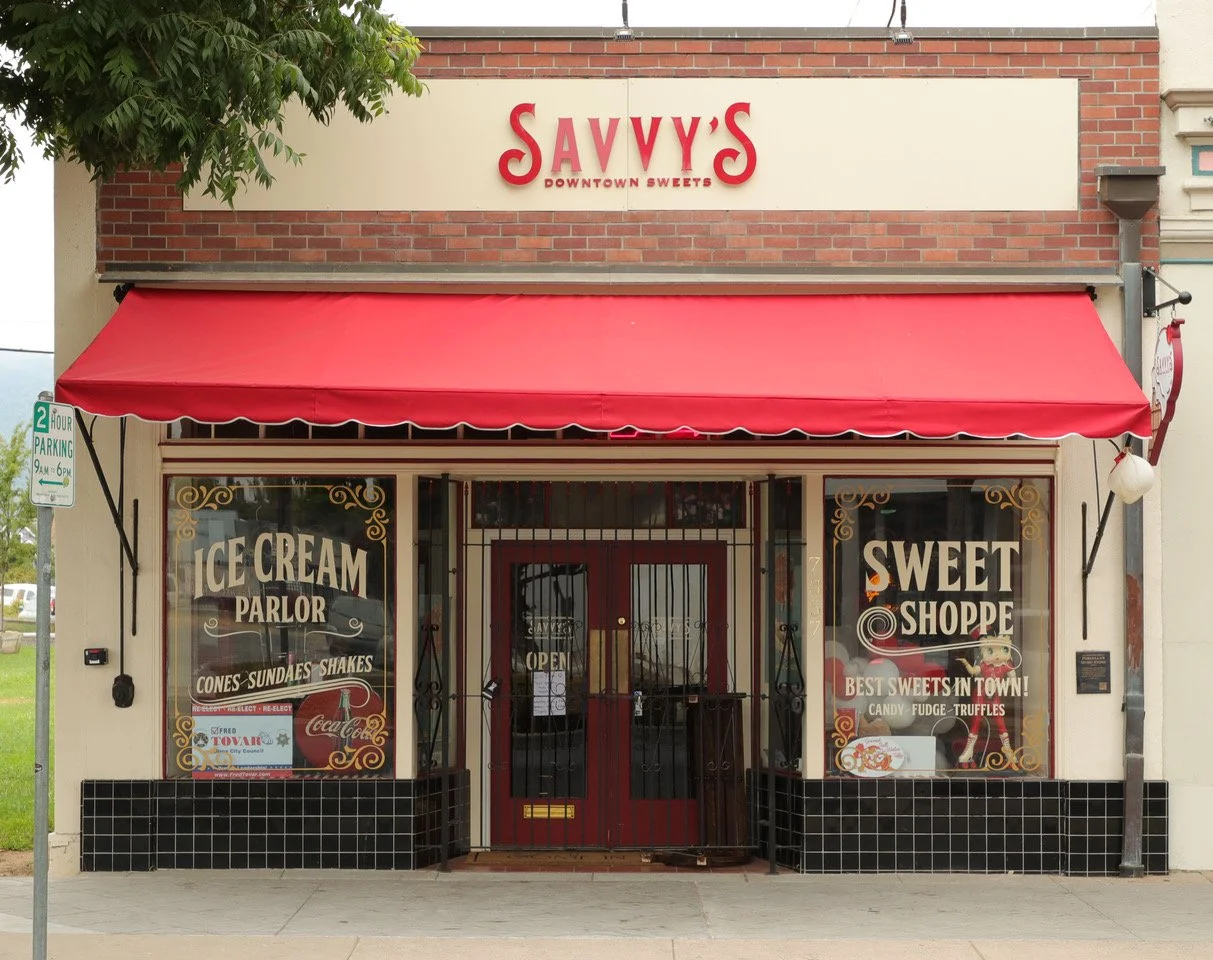
7357 Monterey Street
(1870’s)
PORCELLA’S MUSIC
This single-story brick retail store is unusual in that it is one of the very few structures in Gilroy’s business district which has retained its original design. Built in 1888, it has always been used for commercial purposes. It originally abutted the Louis Hotel and may have been part of Gilroy’s first stagecoach station. Early businesses in this building included a saloon, grocery, and bakery.
In 1898, Charles Porcella, a native of Italy who immigrated to the United States in 1892 and worked as teamster for Miller and Lux in Gilroy, purchased a half interest in a clothing/general store operated by H. L. McDuffie at this location. In 1908, Porcella bought McDuffie out and was sole proprietor of the business until his death in 1922. His death was front page news in the Gilroy Advocate on Feb. 11, 1922, where he was described as “a prominent business man and one of the leaders of the local Italian colony.”
After Charles’ death, his wife, Agnes, leased the store and it operated as a barbershop and a bar known as The 49 Club until 1947 when her son George took ownership and operated the business as a clothing/general/music store. George had been a professional musician during his younger years and led a 12-piece band known as the Merry Makers. He taught music lessons to musicians young and old in the back of the store and had a good selection of musical instruments for sale. As George’s son Dave later described it, the store was a place where one could “buy a suit, a tie, a hat, an instrument and go out and get a gig.”
After George passed away in 1986, his son Dave Porcella, who had grown up in and worked in the store for many years, decided to continue the family business, rebranding the store as Porcella’s Music and transformed it into a purely music-centric establishment. In addition to its Gilroy regulars, Porcella’s was known as the “go-to place” from South County to Salinas, drawing many customers from Hollister, Morgan Hill, Los Banos and other nearby towns. Signed photos of legendary jazz icons hung on its walls and Hollywood stars were known to frequent the store. It was a place where aspiring and accomplished musicians could browse the latest violins, woodwinds, brass, keyboards, amplifiers, harmonicas, guitars and more, or pick up sheet music to learn some new tunes. Broken guitar strings and other instrument maladies were often fixed on the same day, and children would walk out of its doors smiling after mastering basic chords. Porcella’s joy and enthusiasm inspired new musicians and continued the legacy his father built.
After 123 years of family ownership, Porcella planned to retire and sell the store in the summer of 2020. However, the stresses of operating a small business and a steep downturn in sales during the Covid-19 pandemic forced him to close the store and put the building up for sale in March 2020.
Under new ownership, the building has been leased and currently houses Savvy’s Downtown Sweets, a nostalgia-themed ice cream parlor and sweet shop which opened in 2024. Excited to support a new family-oriented business in the building his family owned for so many years, Dave Porcella has donated many items to the store that once graced the building in the early 20th century.
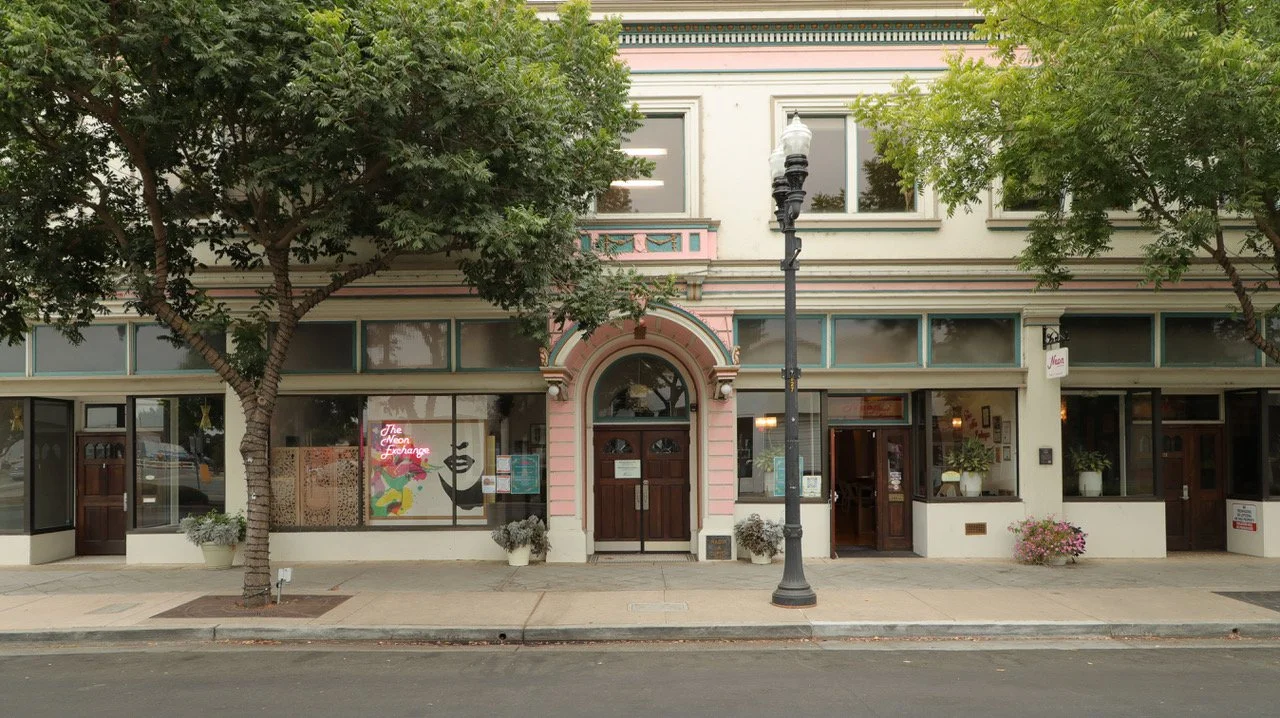
7363-71 Monterey Street
(1921)
LOUIS HOTEL
This two-story Neoclassic style hotel building located in the heart of old downtown Gilroy opened to great fanfare on September 10, 1921. The opening was reported as a festive event attended by 400-500 formally attired guests treated to a “dinner fit for kings” and serenaded by an orchestra and entertainers from San Francisco. Designed by the architectural firm of Binder and Curtiss and owned by Louis Cupich and his business partners John Radin and Mitch Milias, the hotel boasted 25 rooms on the upper floor, 14 with baths and 8 arranged in suites; two public baths, one for each sex, and carpeting extending throughout the halls and rooms. The first floor housed the hotel lobby, a kitchen, a cocktail lounge, and a fine dining room and restaurant called the Louis Cafe owned and operated by Cupich and members of his family. The cafe featured some of the fanciest cuisine between San Francisco and Los Angeles. The Louis Hotel soon became a preferred stopping place for travelers on Highway 101 which ran through downtown Gilroy at that time.
A native of Austria, Louis Cupich came to Gilroy in 1908 from Dalmatia, Yugoslavia, and worked for George Milias Sr. in his restaurant until 1915 when he bought out his employer and went into business for himself with his brother Nicholas Cupich and John Radin. After Cupich and Radin built the Louis Hotel in 1921, Louis bought Radin out in 1927 and continued operating the hotel until 1946 when he sold it to a firm from Salinas and retired. Cupich was active in community affairs as a long-time member of the Gilroy Elks Lodge and the Gilroy Kiwanis Club. He spent the rest of his life in Gilroy passing away at the age of 85 in 1971.
Under its new ownership, the Louis Hotel eventually changed its name to the Old Gilroy Hotel. Over the years, other businesses also operated on premises next to the restaurant and bar, including a barber shop, a grocery/liquor store named McGuerins, and a Chinese restaurant named Leyon’s. Probably due to absentee ownership and increasing age, the hotel went downhill and fell into disrepair in the late 1960s and early 1970s.
A group of businessmen led by majority owner Tom Bidgary of Hollister purchased the building in May 1978 with plans to restore the first-floor restaurant and cocktail lounge to its former glory, install an elevator, and convert the upper floor hotel rooms to modern office spaces. The repair and restoration efforts which included removal of the original hotel room claw-footed bath tubs (all quickly snapped up by antique collectors) continued until March 1982, when the Old Gilroy Hotel Restaurant and Bar finally opened for business. The new owner and manager spared no expense to ensure the decor, furniture, wall murals, light fixtures, even the dress of the wait staff, captured the original 1920s flavor of the restaurant.
After several years of successful operation as a venue for live bands, dancing, and dining, the general decline of the Gilroy downtown area spelled the end of the Old Gilroy Hotel Restaurant and Bar. The building was purchased in July 1990 by a limited partnership who managed to attract a few business tenants in the succeeding years, but eventually the building became vacant and abandoned. In 2018, the building was purchased by its current owner Toni Bowles, who, renovated the building restoring as much of the original as possible. She created The Neon Exchange, a business that provides lease spaces, work stations, desks, and conference rooms for female-focused small businesses and community group meetings and activities.
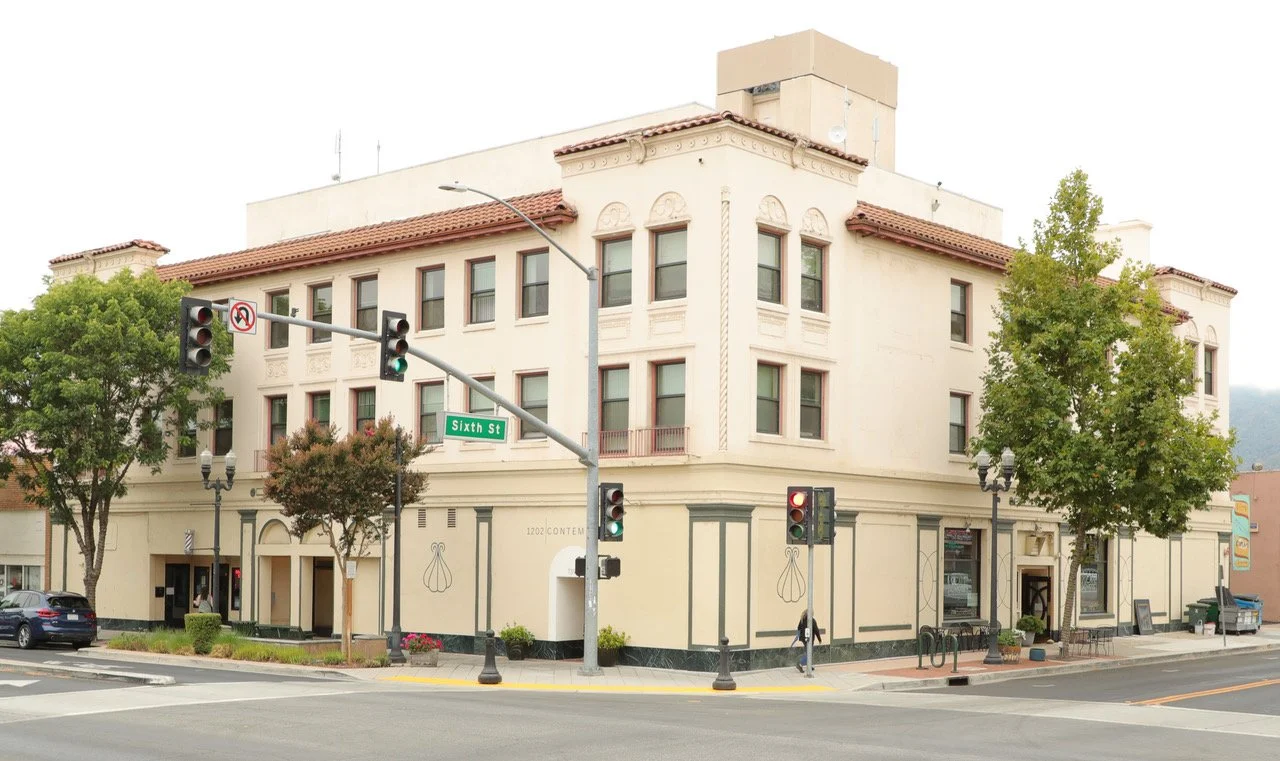
7397 Monterey Street
(1922)
MILIAS HOTEL
This Spanish Colonial Revival building, located at the intersection of Sixth and Monterey Streets just south of Gilroy’s busy downtown shopping and entertainment district, is easily the most massive structure in the area. The Milias Hotel was originally designed by William Weeks and built by James Patterson in 1922 for $200,000. It was built to be a hotel, with a basement, three floors, 60 rooms, and a garden roof that was used for dining and dancing. Off the roomy entryway was a grand double dining room, and on the fourth floor, a bright, airy space referred to as “The Sun Room” was also used for dining and dancing. The Milias Hotel was the first three-story building in Gilroy, and the elevator installed in this hotel—the first in the city—was quite the novelty in the community at the time, especially to local kids.
The original owner George Milias, Sr. came to San Jose from his native Yugoslavia in 1881 where he owned and operated a successful restaurant for ten years before relocating to Gilroy. He operated another café and hotel on the site called the William Tell House. He also ran the Milias Chop House in 1895. It was after the addition of the Monterey Highway (then a brand-new Highway 101) right through Gilroy that Milias seized the opportunity to tear down the Chop House and convert his business to the The Milias Hotel and The Milias Restaurant and Steakhouse.
Through the 1920s, 30s, and 40s, the Milias Hotel’s central location between Los Angeles and San Francisco attracted the Hollywood elite, including Clark Gable, Bing Crosby, Frank Sinatra, Abbot and Costello, Carole Lombard, Will Rogers, Tennessee Ernie Ford, and John Wayne, who visited while raising cattle at a nearby ranch. Other notable visitors included former U.S. Presidents John F. Kennedy and Dwight D. Eisenhower.
It was a popular destination during Gilroy’s “Cowboy Era,” when the Gilroy Rodeo (known as the Gymkhana), which ran from 1930 to 1956, was the place to be. Milias himself owned his own cattle ranch on Pacheco Pass. George’s wife encouraged the cowboy motif with the addition of a unique 57-foot horseshoe shaped bar and a large painted mural above the bar depicting Gilroy’s cowboy and western era.
Milias and his wife inhabited a second-floor apartment for many years and their son George Milias, Jr., ran the hotel after them. The family was socially prominent and active in civic affairs. George Milias, Jr., served as Mayor of Gilroy from 1940 to 1954 and again from 1956 to 1958. His son, George Milias III was a California State Assemblyman for several years, later becoming Deputy Director of the Fish and Game Commission in Washington, DC.
When the current Highway 101 bypassed Gilroy and Monterey Highway was no longer the main thoroughfare from Los Angeles to San Francisco, the restaurant changed hands, and the hotel rooms were converted into apartments. However, the Milias Restaurant name was retained and continued to be a go-to place for Gilroyans, hosting various special events and live music performances throughout the years. It was a favorite among downtown diners for its menu of classic and comfort fare in a Western-themed setting.
From 1964 to 2011 the restaurant was known as the Harvest Time restaurant until its new owners reverted to the original Milias name as part of their efforts to recapture its historic past. In recent years, the building and restaurant have become well-known to paranormal investigators and fans due to reports by its owners, guests and employees of ghostly figures (mostly friendly and helpful according to the witnesses), strange sounds and other eerie, unexplainable phenomena.
Unfortunately, the declining number of customers caused by the closure of the popular Gilroy Garlic Festival and the Covid-19 pandemic forced the owners of the Milias to close the restaurant in August 2023. Today, the building still contains rental apartments and the former Milias Restaurant is now an art gallery, upscale cafe, and retail space.
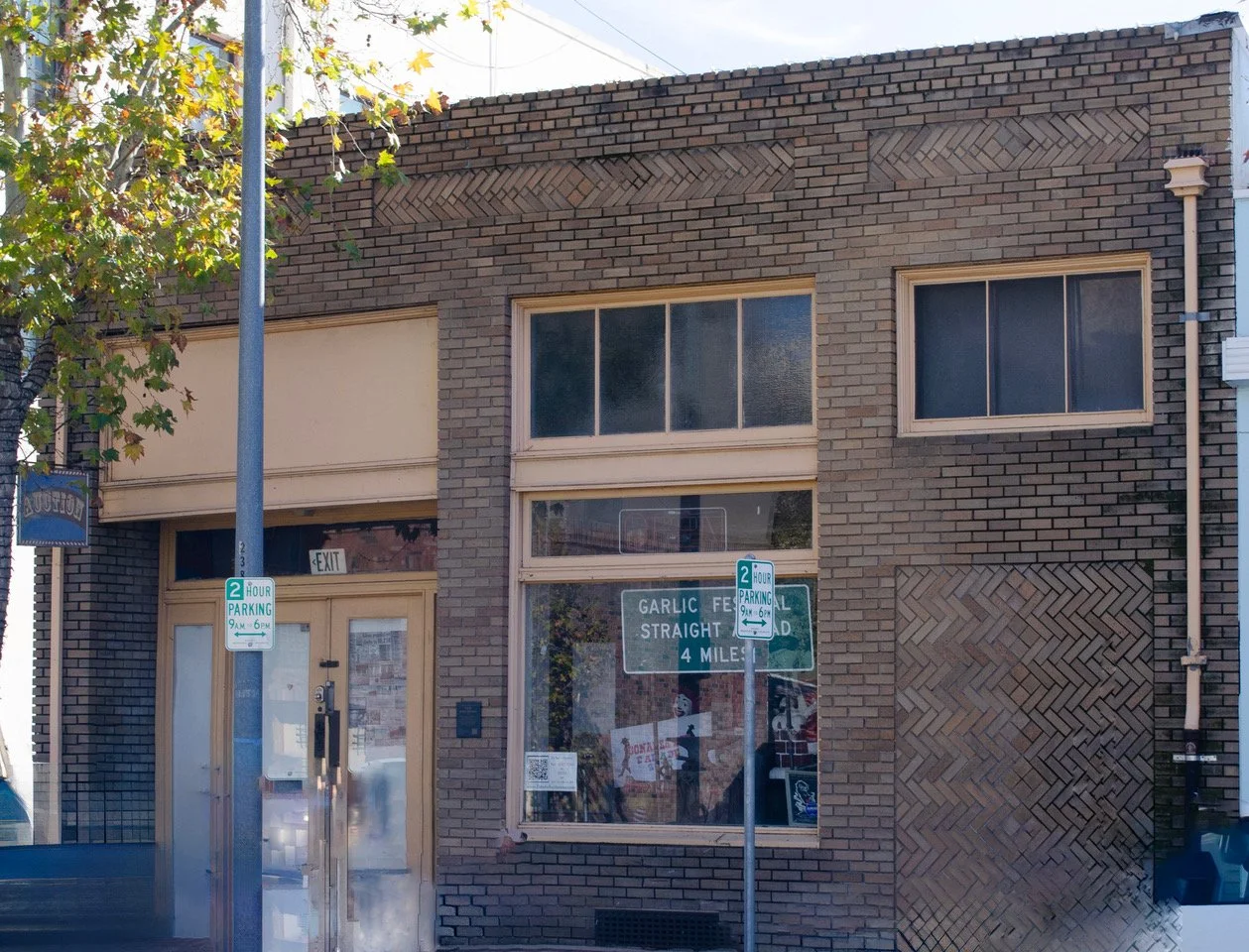
60 West Sixth Street
(1920)
OLD POST OFFICE
This building is a prime example of Commercial Architectural Style, known as Early Brick Commercial, which refers to buildings built with brick in the early 20th century. These buildings were often built with one to five stories and had a flat or slightly pitched roof. This single story reinforced concrete structure with a press brick facade is known locally as the Old Post Office.
As a group effort in 1920, local entrepreneurs and civic leaders, including former mayor, Michael Casey, received approval from the U.S. Post Office to construct a new post office building on Sixth Street. Together with Postmaster Samuel Moore and contractor William Radtke, Mr. Casey researched post offices as far North as Burlingame to ensure the new Gilroy facility would be efficient. The building retains architectural interest and is important in relationship to the other small commercial structures on the block and to those on Monterey Street.
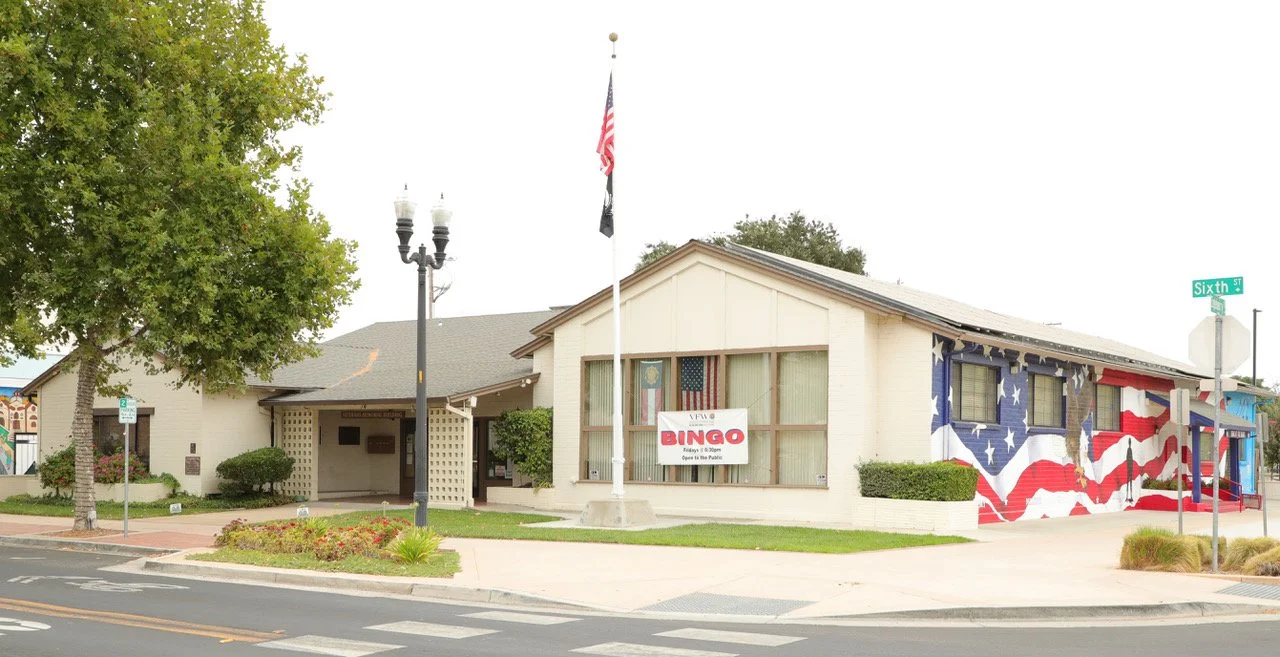
74 West Sixth Street
(1949)
Veterans’ Hall
Members of the Gilroy community service clubs concluded in 1945 that a building dedicated to veterans should be constructed. The property on 6th Street was secured and the South Santa Clara Valley Memorial District was established and managed by a board of directors. Over the next few years funds were raised for the new building by implementing a local tax assessment. The 6,352 square foot Veteran’s Hall was built by William Radtke and opened in May of 1951.
Mayor George C. Milias presided over the opening ceremonies and was joined by Lieutenant Governor Goodwin C. Knight who conducted the dedication ceremony. Also in attendance were state heads of the American Legion and Veterans of Foreign Wars. Today the hall serves as a meeting hall for four veterans’ groups, including the American Legion Post 217, and its Auxiliary, and the Veterans of Foreign Wars Post 6309 and its Auxiliary. The hall is also available to all residents of the District service area, including all members of the armed forces, non profit groups and the general public. The mission of the District’s board is to provide a quality, first-class facility to make the community proud.
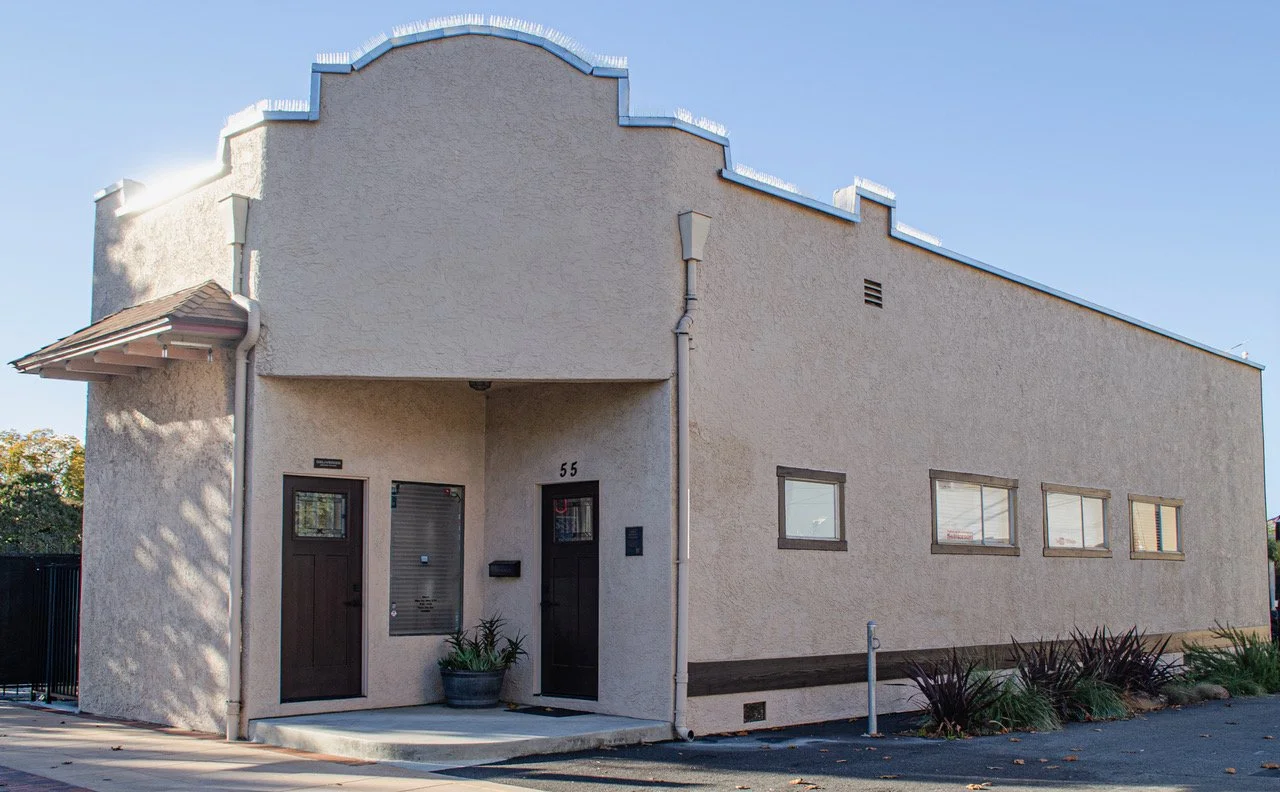
55 West Sixth Street
(1916)
THE ADVOCATE BUILDING
On February 5, 1916, the Gilroy Advocate moved into to a newly constructed building built by contractor William Radtke specifically for the newspaper. The design and form are one of Gilroy’s finest examples of Mission Revival Industrial Architecture, which was popular from the 1890s to the 1920s. The significance of the structure is derived from both the history of the Advocate and the Commercial Mission Revival Architecture. The building is commonly known as Gilroy Taxi, which operated out of the building in the past, but also historically referred to as the Gilroy Advocate Building.
The Advocate is Gilroy’s first newspaper started in 1868 by G.M. Hanson and C. F. Macy who published the first edition on September 12, 1868. In 1877 the Advocate was purchased by Frederick W. Blake who ran the newspaper for about three decades until his death in 1907. The Advocate remained in the family under Mr. Blake’s son, William F. Blake Jr., who was the new editor and owner after his father’s death. It was W.F. Blake Jr. who purchased the Benn property on West 6th street one half block from Monterey Street for the new home of the Advocate.
The following era (1933-1941) was known as the Consolidation Era. In 1933 the newspaper was sold to Lloyd E. Smith and merged with the Gilroy Evening Dispatch, which was launched in 1925. From 1933-1939 the two newspapers were published as separate weekly (The Advocate) and daily (The Dispatch) publications. In 1939 Mr. Smith sold the publications to the Gilroy Publishing Company operated by Anderson Browne and James Marmaduke. The company continued operation of both publications concurrently until 1941 when the publications were sold to William G. Werner. Mr. Werner continued to run the Advocate as a weekly and the Dispatch as a daily. Finally in May 1949 the Advocate was absorbed by the Dispatch and ceased as a standalone publication.
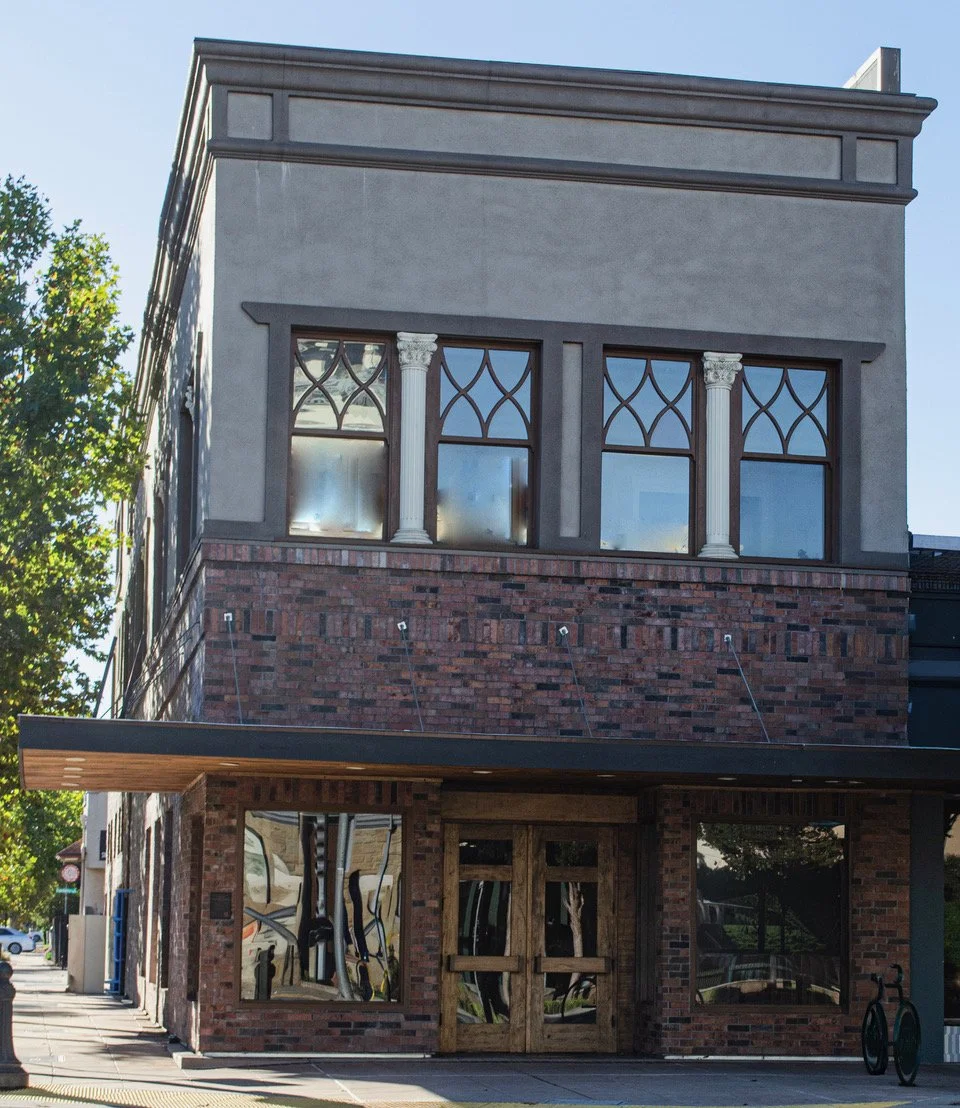
7401 Monterey Street
(1872)
ELLIS BUILDING
The James Ellis Building commonly referred to as Hall’s Western Wear or Hall’s Mercantile, was built in 1872 and is the oldest building in the city of Gilroy. Previously home to the Fraternal Order of Eagles which occupied the second floor and a variety of commercial uses on the ground floor, the building has been a haberdashery store during most of its existence. In 1926, Silverstine’s occupied the building, then the Regent, later Brown’s and then for many years Hall’s, where generations of families bought their Levis.
The building was also known for its landmark horse and rider on the awning roof. The full-sized figure depicted world champion rodeo rider Casey Tibbs and his horse, War Paint. The sculpture modeled the rider and horse in action with the horse’s front hooves in a downward motion and the hind legs elevated while kicking as the rider held on for the ride. Although this form of advertising art is almost entirely a medium of the past, in its heyday it was a favorite icon in downtown Gilroy. The Gymkhana (rodeo) held from 1929 to 1956 was part of Gilroy’s cowboy era. Gymkhana Committee meetings were held across the street at the Milias Hotel whose owner, George Milias was a prominent rancher.
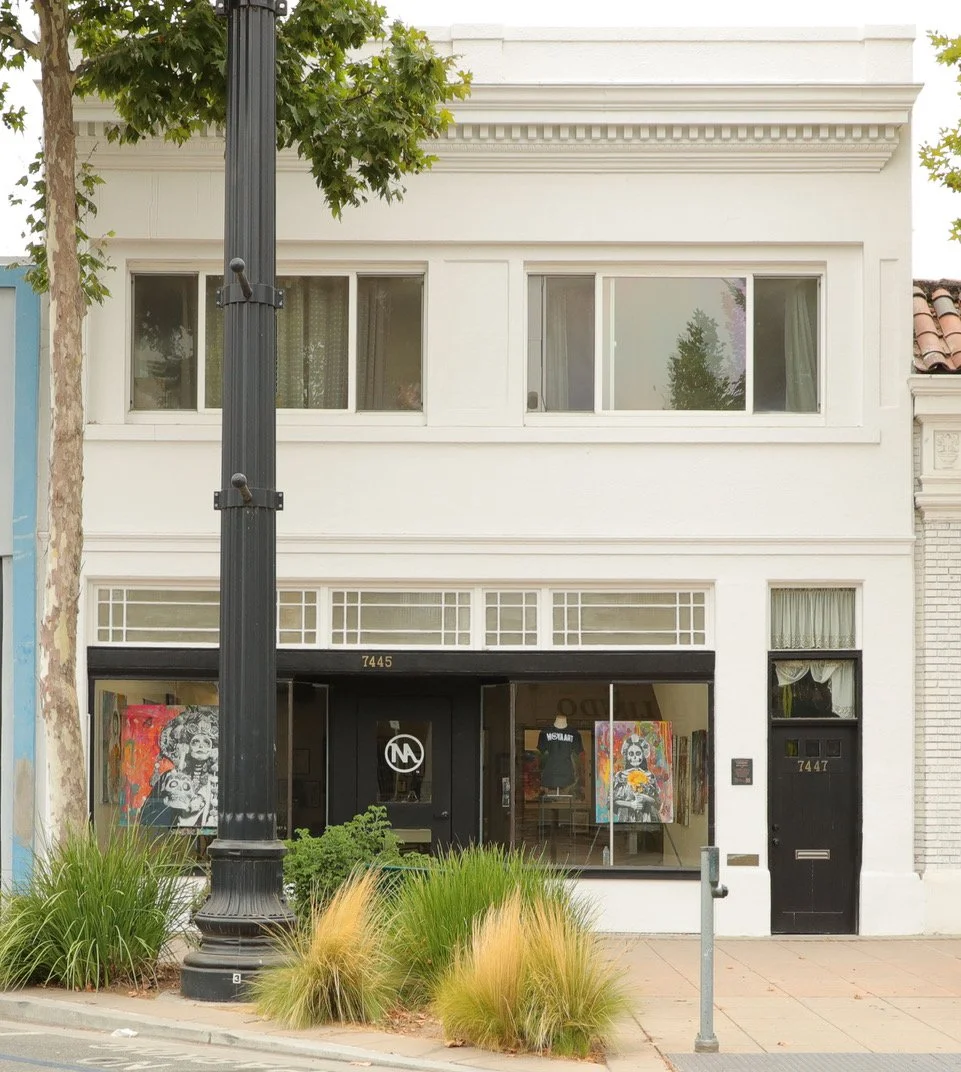
7445 Monterey Street
(1917)
CHESBRO BUILDING
Commonly known as Gilroy Hardware, the Chesbro Building was built in Neoclassic Style by William Radtke between 1915 and 1917. This is an important structure in Gilroy revealing what may have been present prior to stripping and stuccoing so many structures. One of the larger structures in the center of the block, it keeps the rhythm of the two story structures and anchors the attractive single story structures that adjoin the building.
Doctors H.R. Chesbro and his son, Elmer J, had their medical practices on the second floor. And at one time the building was home for the much traveled Gilroy Hardware Company, owned by Don Chesbro. In the recent past, the lower floor has been occupied by a series of cafes, grills, and an antique store.
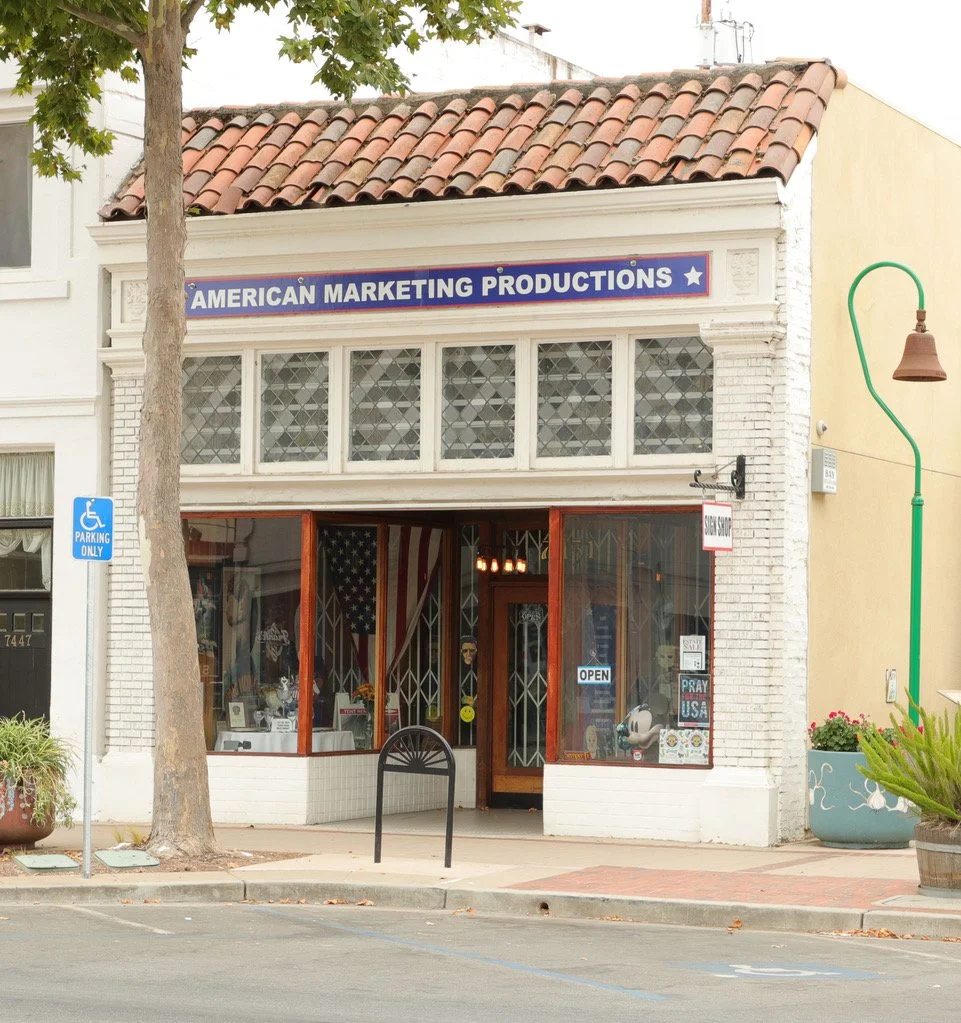
7451 Monterey Street
(1924)
JOHNSON DRUG STORE
Gilroy’s Downtown is unusual because most buildings you see were constructed between 1900 and 1920, unlike most small downtowns that have been rebuilt many times.
Small cities and towns like Gilroy provided all necessary goods and services to the community because travel was difficult and expensive.
In the 1890’s Gilroy’s population was approximately 1,700 people. There were several doctors, but no hospitals until 1898 when Dr. Jonas Clark established the Gilroy Private Hospital for emergency care in the Rea Building on the corner of Fifth Street and Monterey Street.
Three Generations of Pharmacists:
Two years prior to that in 1896, Edward Johnson, a trained pharmacist, started Johnson Drug Store in a two-story wooden building at the 7451 Monterey Street site.
The Johnson Drug Store story begins long before the drug store itself. The Johnson Family – Julius Martin, a North Carolina-born pioneer, arrived in the Gilroy area (San Ysidro) in 1843 making his family one of the earliest non-Hispanic settler families. His daughter, Georgina Martin, married Dr. James Franklin Johnson in Gilroy in 1869.
There is an interesting local history wrinkle here: Dr. James Johnson, appears to have practiced medicine in the early years of Gilroy’s history around 1864. An 1868 Gilroy Advocate article praised Dr. Johnson for personally paying to improve a wooden sidewalk in front of the Johnson block on Monterey Street. The Johnsons continued to own the property along this street until the late 1890’s when Johnson Drug Store was established.
Their son, Edward Franklin Johnson (1870-1917) became the pharmacist who established Johnson’s Drug Store in 1896. Edward Johnson was active in civic affairs including serving on the board of Dr. Jonas Clark’s Gilroy Private Hospital and a nurses training school in Gilroy in 1897.
When Edward died in 1917 his eldest son, Edward Martin Johnson (1901-1945) took over the business after graduating from UC Berkeley in 1922. He then went on to start a small South Valley Pharmacy chain of three stores: Gilroy, Morgan Hill, & Watsonville. By 1920 Gilroy’s population had increased to over 2,900. In 1924 the original wooden building was demolished and rebuilt as you see it today as part of a 1920’s era Downtown revitalization effort.
An interesting anecdote from the Prohibition era – medicinal alcohol could legally be prescribed under certain circumstances. On June 10, 1926, Gilroy businessman George Milias, Sr. obtained a prescription for whiskey and had it filled at Johnson’s Drug store. A reproduction of the prescription was on display at the Milias Restaurant, Sixth and Monterey, for many years.
Martin Johnson died in 1945. He was a young man only 43 years old. His younger brother, Garrett Abeel Johnson (1903-1971) then took over the family pharmacy. Garrett continued operating the store until his death from an automobile accident in 1971.
Description of Existing Building:
Palmer & Gurries built the new store in the Mediterranean Revival style that was very popular at that time. Directly next door, 7445 Monterey Street, was the Chesbro Medical Building, occupied by Dr. Heverland Chesbro and his son, Dr. Elmer Chesbro. The pairing of a doctor and pharmacist next door to each other was a very traditional arrangement for a small American town. Another example of this pairing arrangement was that by 1920 Dr. Hugo Schmitt’s office was upstairs in the original two-story structure.
In 1924 the original cabinets from 1896, constructed of oak and glass, were installed in the new building. They are still in use today. In 1985 the City of Gilroy Historic Resources Inventory described the exterior architecture as Mediterranean Revival with a relatively original presentation of the original structure. This single-story rectangular building is an important component of Old Gilroy Streetscape. The unaltered door, glass panel in wood frame is deeply recessed from the sidewalk. The entryway is the original black and white mosaic tile in a checkboard pattern. The display windows angle to provide maximum exposure. Brick facing forms a column effect at each end of the storefront. Simple capitals appear to support a plain frieze with a molded cornice. The fenestration band above the sign has 6 windows of diamond pattern glazing; an unusual treatment that provides a touch of distinction. Upper windows of adjacent buildings have been painted or covered with other materials, thus obscuring or limiting their original design. This structure is the basis for the cohesive style of single-story commercial structures along Monterey Street.
This building reflects the elements of commercial design appropriate to this type of structure on Monterey Street. This stripped-down version of the neoclassical revival is the mainstay of continuity in Downtown Gilroy. The loss of this structure would not only destroy an individual resource but would seriously damage the integrity of the commercial area.
The Johnson family operated the store for 75 years from 1896 to 1971.
1971 – Present:
After Garrett’s death, the pharmacy business ended and the building went through several incarnations; a variety of small businesses including textiles, coffee, newspapers, and even a gun shop.
The Johnson Drug Store building is part of a particularly interesting historic block that was originally owned by the Johnson Family: 7401 Monterey, the Ellis Building, is the city’s oldest building from 1872. 7445 Monterey, the Chesbro Building, was home to Dr. Chesbro’s office, and 7451, Johnson’s Drug Store from 1924. The Johnson Drug Store building sits in a remarkably concentrated section of historic Monterey Street where you can see the transition from 19th century Gilroy to the automobile era downtown of the 1920’s.
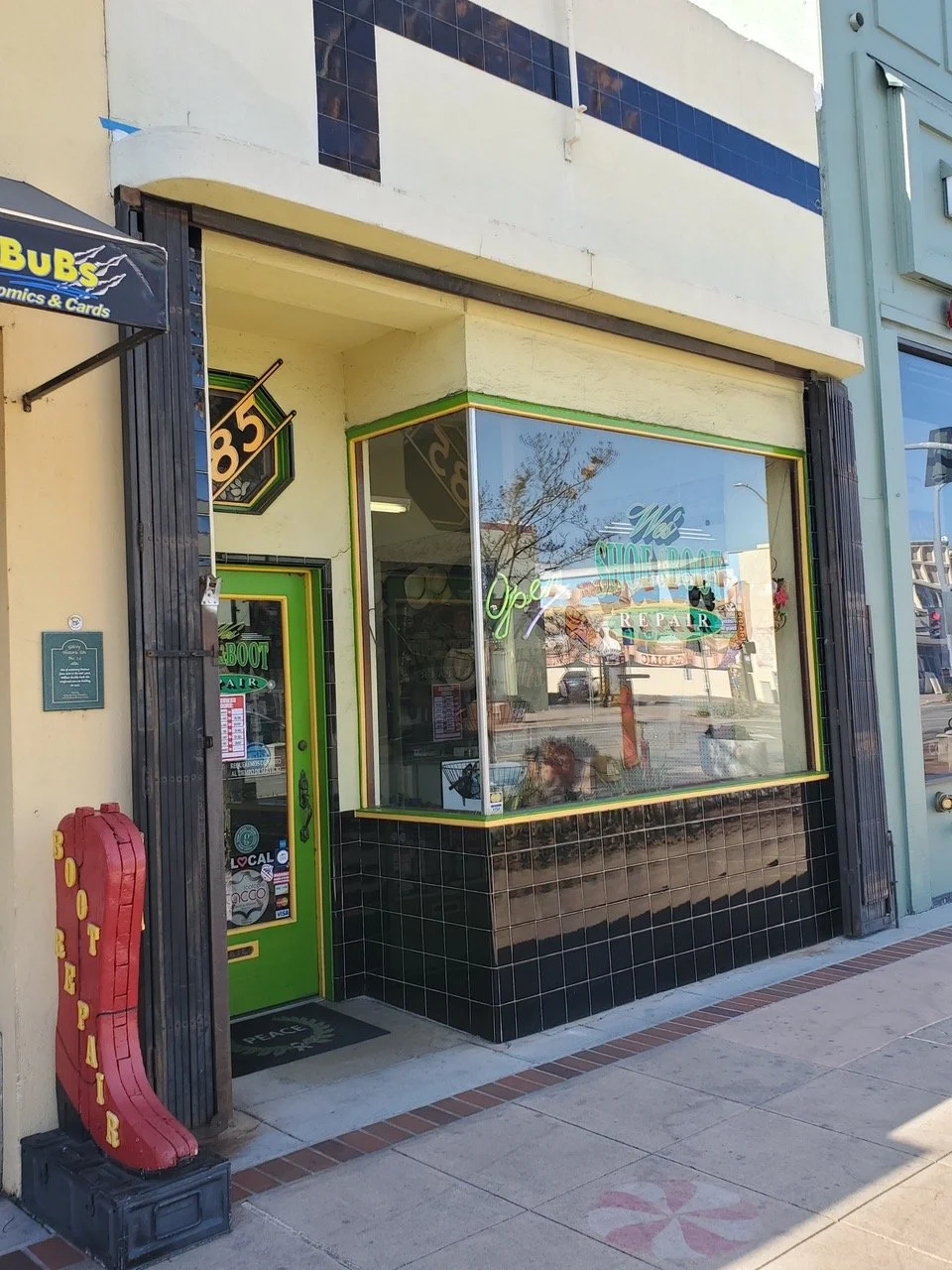
7485 Monterey Street
(1941)
GILROY SHOE REPAIR
This single-story structure in the downtown commercial district is constructed of brick and has a black tile façade. It was built in 1890 and originally was used as a millinery shoppe (1892), and then became a jewelry store (1906). In the 20’s and 30’s the structure was remodeled in the moderne style and used as a commercial office space by A.W. Brown Real Estate and later by G.B. Rodeck Insurance Company.
In the early 1980’s, Job and Edwina Camarena rented space in the Nob Hill Shopping Center to operate a leather materials repair and retail store. Around this same time, Wes Stallings, a successful radio ventriloquist, with a ventriloquist dummy named Eddie O’Toole, contacted Job and expressed interest in purchasing his repair business. Job trained Wes and helped him open Wes’ Shoe & Boot Repair at 7485 Monterey Street in Gilroy (Listen to “Here Comes Stallings” comedy act here).
Unfortunately, after only four months of operation, Wes became seriously ill and decided to sell the business back to Job and Edwina. They retained the original name in honor of Wes who passed away shortly after. Their son, Job Camarena II took over running the business in 1993 and has been running the business ever since.
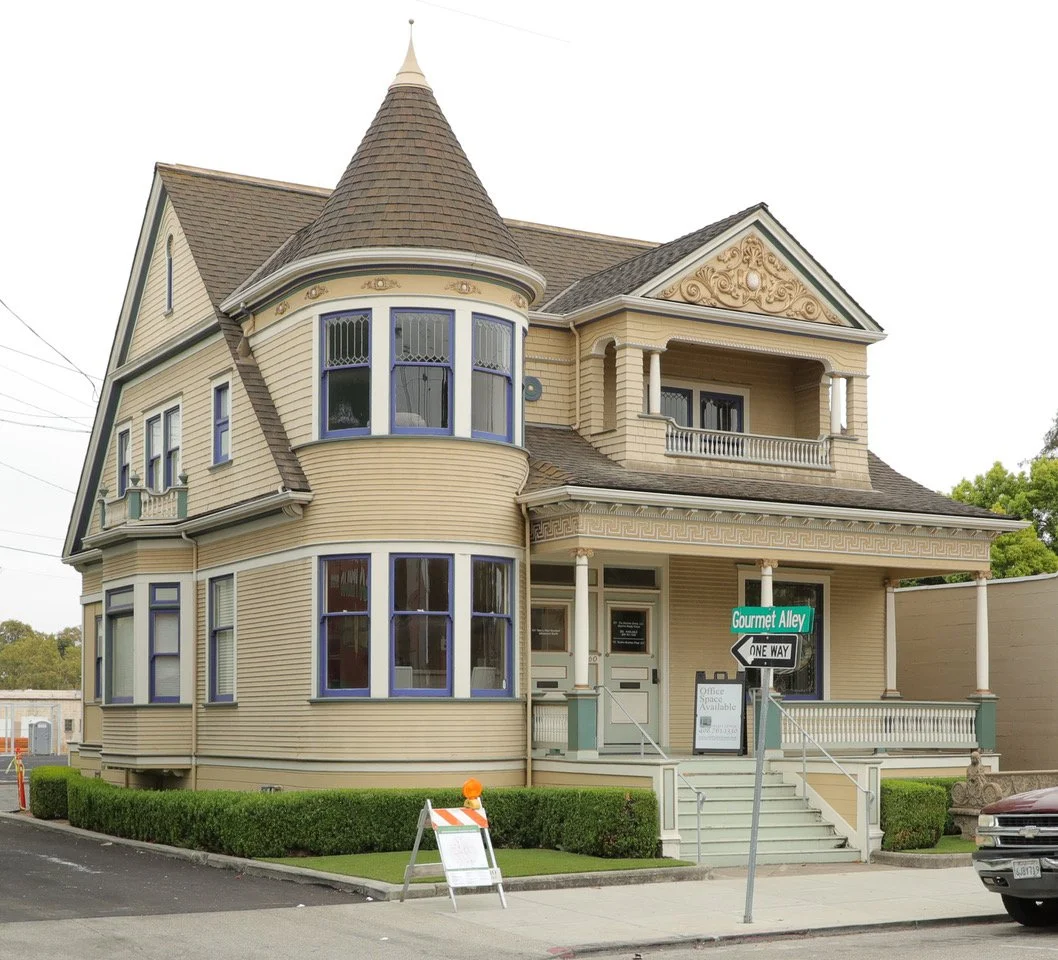
60 Fifth Street: Weaver-Tremaine House (William Weeks; Queen Anne Victorian, 1900)
More information coming soon…
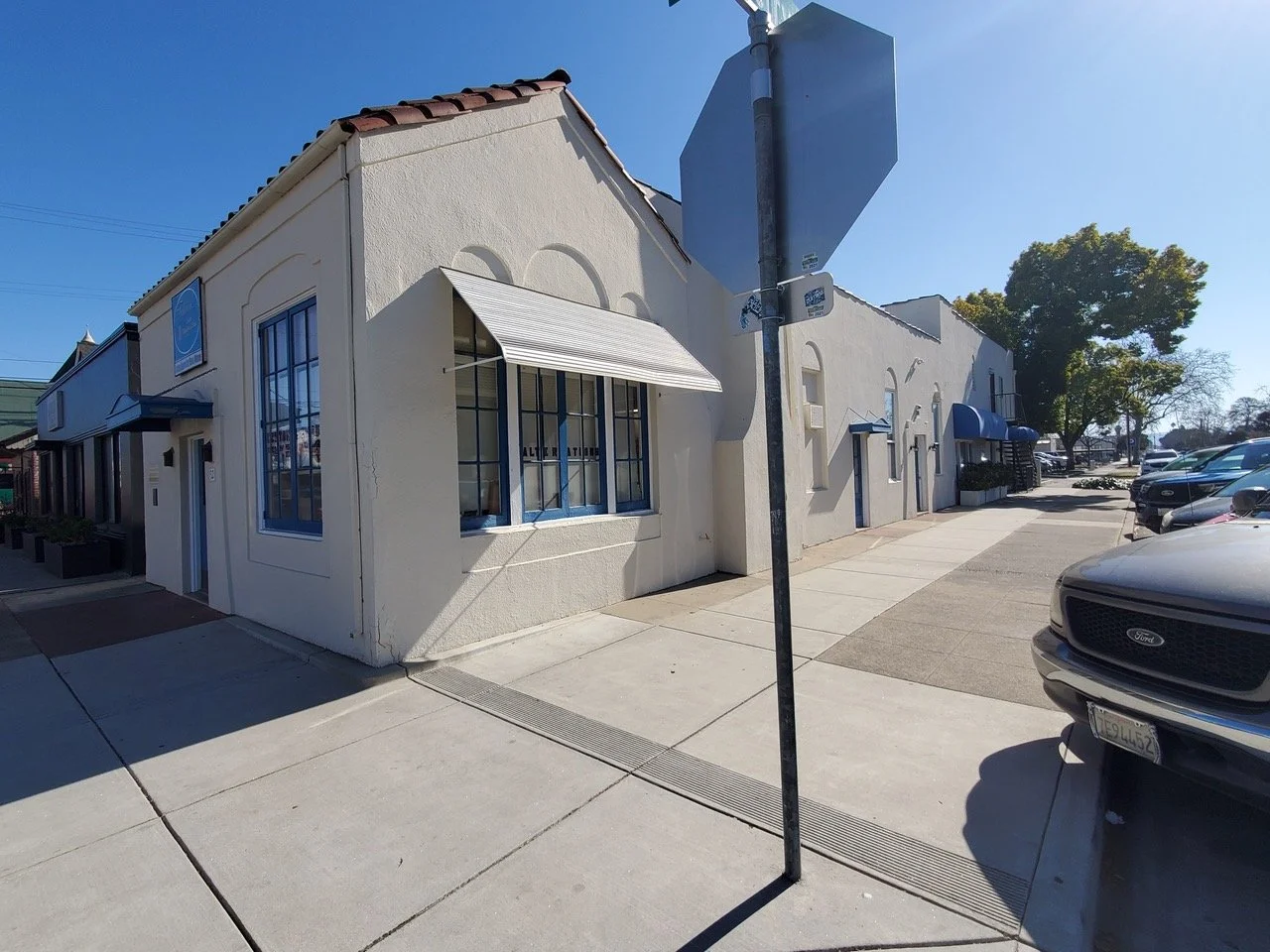
92 Fifth Street
(1926/1927)
AMERICAN LEGION HALL
The American Legion was chartered by Congress in 1919 as a patriotic veteran’s organization. Focusing on service to veterans, servicemembers, and communities, the Legion evolved from a group of war-weary veterans of World War I. Local posts sprang up across the country (legion.org). Gilroy’s American Legion Post 217 was granted a charter on June 10, 1921.
The building on 92 Fifth Street in Gilroy was built by volunteer members of the local post between 1926-1927 under the leadership of Phil Cox, commander of Gilroy Post 217. The concrete foundation “was going up with a whiz-bang” in March 1927 by “hauling gravel from the Uvas Creek bed at the Jim Thomas place” (The Advocate, 3/16/1927). The building was dedicated in October 1927 with a gala event that included flags, flowers, ceremony, and “an inspection of the armory and building…followed by dancing in the old hall (the old Music Hall) and card playing in the new building” (The Advocate, 10/8/1927).
It is a single-story structure covered in stucco and has small pane windows. The roof is flat with Spanish tile crests. The Spanish Colonial Revival style was chosen as a tribute to Gilroy’s early heritage. (Historic Resources Inventory, 1986)
The building was originally used as a meeting hall for the American Legion Post 217 until the Santa Clara Valley Memorial District Building (Gilroy Veterans Hall) was built on Sixth Street in 1951. Judge Klarich owned and used the structure as law offices in the 1960’s. James Langdon, II, purchased the property in the early 1970’s and is still the owner. A dance studio, church, hair salon, and a collection agency have had offices in the building. It is currently occupied by Fidelina’s, a sewing and alterations shop.
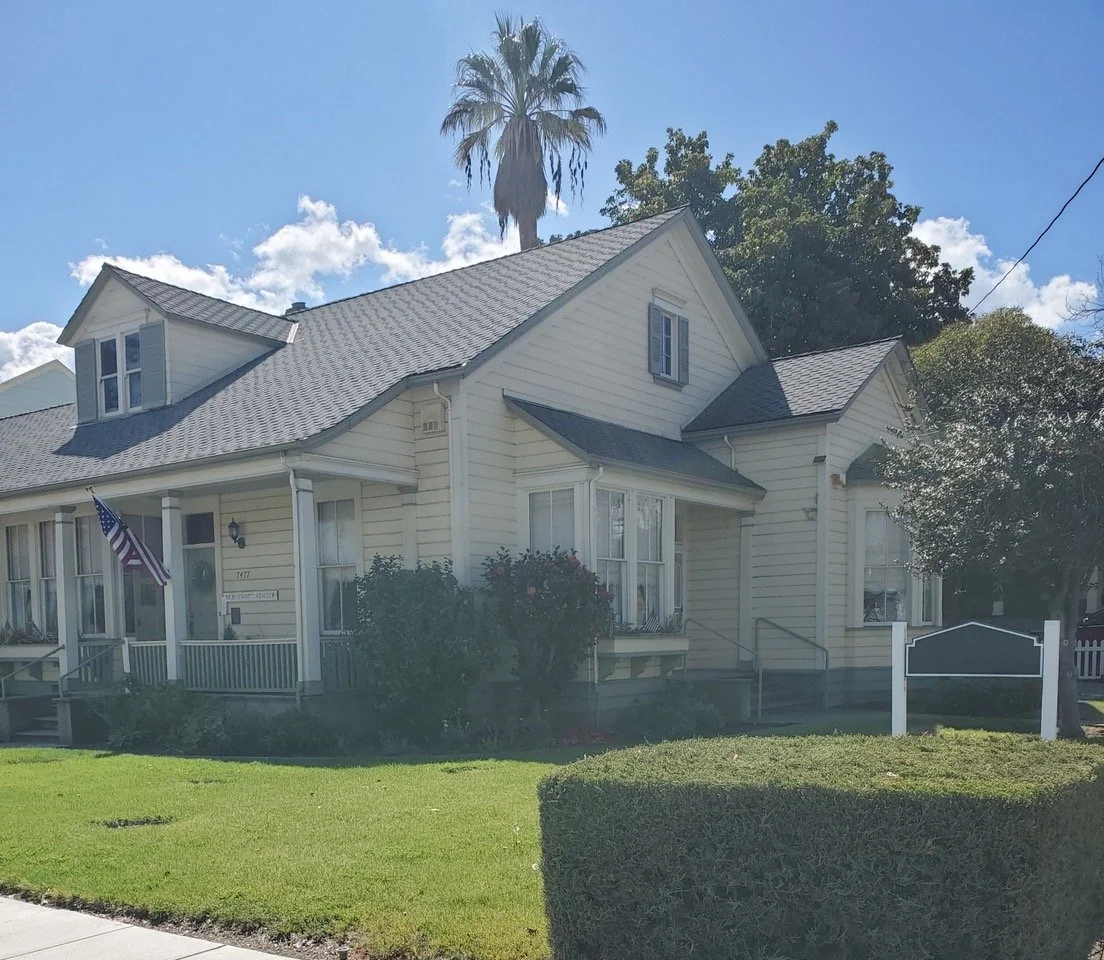
7477 Eigleberry Street
(1882)
AMOS ROBINSON HOUSE
The long rectangular building located at 7477 Eigleberry Street, owned by Starritt Realtors, is a one and a half story house with wide clapboard siding. It has a large dormer and a glassed-in porch. The recessed open porch is supported by square columns and wood slat balusters. On the Fifth Street side, there is a small side entrance and a bay window. The lot was purchased in 1880 by Amos Robinson, but the house was not completed until 1882. (Historic Resources Inventory, 1986) The home was remodeled in 1927, and the streets adjacent to the property were paved in 1928 (The Advocate, 25 Nov. 1927).
Amos Robinson was born and raised in Meigs County, Ohio (circa 1830’s-1840’s) and trained as a tinsmith. He transversed the continent three times via three different routes before establishing his home and family in Gilroy. On his first trip west in 1853 he joined a wagon train and agreed to herd “several hundred head of cattle” across the plains. He arrived in Marysville on 10 September 1854 and remained there for 12 years. After being a miner for six years (“not profitable”), he returned to being a tinsmith for the next six years all the while being “thoroughly homesick”.
In 1867 Amos returned to Ohio via the Isthmus of Panama, which was a vital route for people traveling to and from the gold fields in California. Travelers would board a ship from San Francisco to Panama, take a train across the land bridge, and then take another ship to the eastern part of the United States. He only stayed in Ohio for three months and then returned using the same Panamanian route. This time his destination was Gilroy in the southern part of the Santa Clara County because the railroad was coming through, providing for growth and economic opportunities.
Amos’ third trip back east was to marry Matilda Cline in October 1869. Fortunately, the transcontinental railroad had just been completed in May of that year. After the wedding, the couple returned to Gilroy on the train to make their home in Gilroy. (Robinson Family History, Gilroy Museum). In Gilroy he opened a machine shop and later a very successful hardware store on Monterey Street.
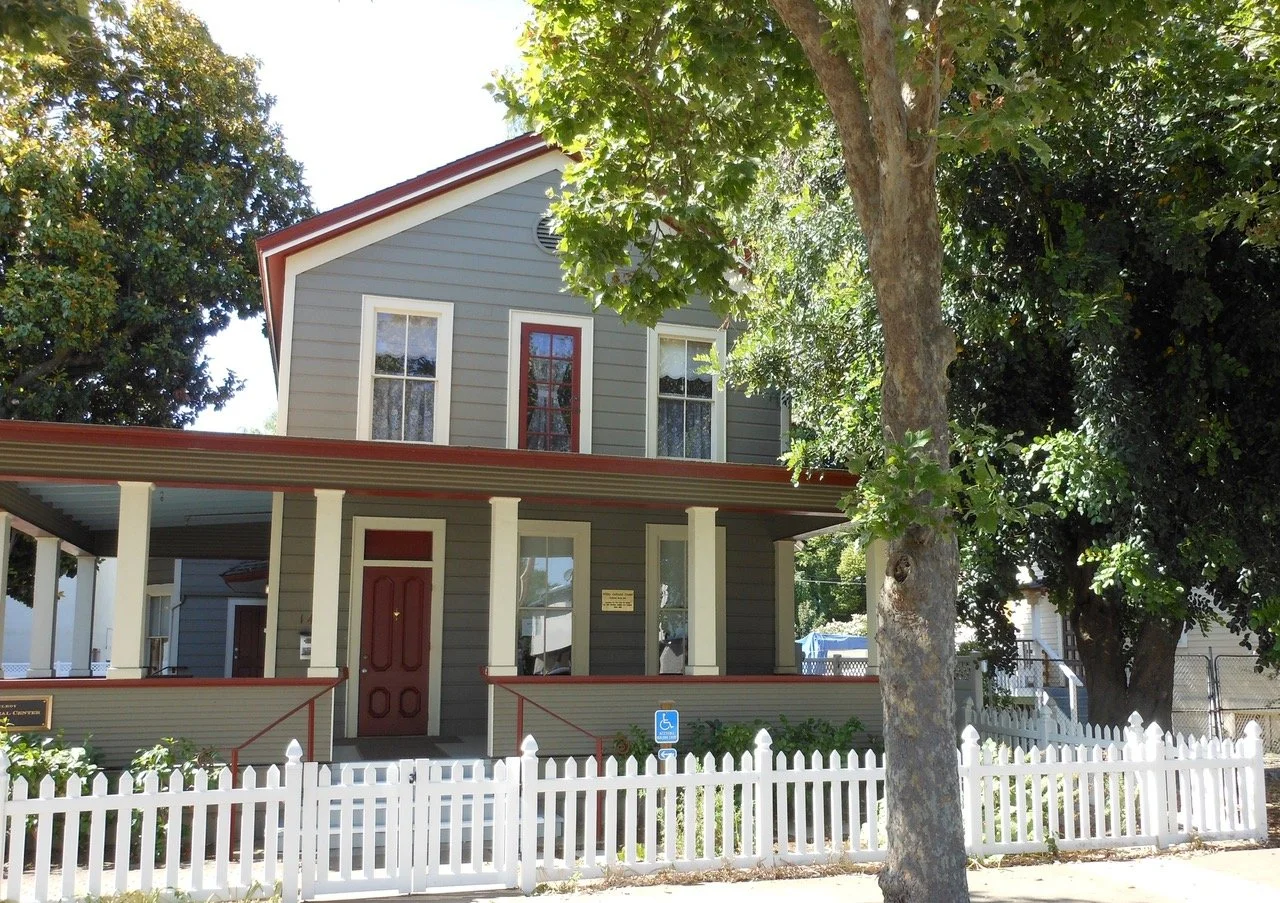
140 Fifth Street
(1857)
WILLEY HOUSE
The Rule-Willey House was built in 1857, for Reverend James King Rule, founding pastor of the Gilroy Christian Church, which was built the same year. Reverend Rule had come from Missouri to Gilroy with his wife and four children in 1855. The materials, fixtures and construction techniques in both the church and the residence are the same, leading local historians to believe both buildings were built by the church congregation. The house was originally a modest Folk National style structure with a simple porch on the north end.
When Elder Rule died in 1882, the house passed to his daughter Eliza Eleanor Rule Wentz, wife of Christian Wentz, a farmer in the San Ysidro district near Gilroy. In the spring of 1893, the Rule house was sold to Judge Howard Willey. Willey, his wife Sarah, and their two daughters Grace and Minnie had arrived in Gilroy in 1876, from Iowa. After managing a general merchandise store for a few years, Mr. Willey was elected Justice of the Peace for Gilroy Township in 1883, and later also became the Police Court Judge.
Both daughters, Grace and Minnie, were accomplished musicians and after the family moved into the house, they made several structural changes to the building to reflect their interest and passion for music and the arts. Two bay windows were added to the west side of the house, including a square bay window which was specifically installed to accommodate a grand piano. French doors replaced a window on the east wall of the back parlor allowing access to the new music room where lessons, concerts and musicales were given by the sisters.
The rear room, formerly the kitchen, was converted into a dining room on the west side, and on the east side an office for Judge Willey was added. A new kitchen was constructed behind the dining room, covering the original outhouse site. The Judge would often conduct court and judicial business from home, and to preserve the family’s privacy a separate exterior door was installed just north of the Judge’s office. This separate entrance was used by the City Marshal and prisoners, as well as other community members seeking his advice and services.
A large veranda style porch was added to the exterior in 1915, which extended across the front of the house and along the east wall, and gave it the more modern look of the Craftsman period.
Judge Willey especially loved nature and floriculture, and was known for his extensive flower and vegetable gardens, as well as the huge magnolia tree on the east side of the house. Many times visitors would leave the home with fresh vegetables or cuttings from his garden. Judge Willey did much to beautify his home and the Gilroy community. In addition to the large gardens on his property, he also planted gardens in other locations around town, and his love of nature led him to support city beautification efforts.
Judge Howard Willey died in 1919, after having served as judge for 36 years, as well as Deputy County Clerk for Santa Clara County, and as a special correspondent for the San Jose Mercury. The house stayed in the family after his death, until it was purchased by the Theater Angels Art League (TAAL) in 1973. The following year the group opened the building as a cultural center, and it was run by volunteers from Theater Angels. During this time small improvements were made on the house, and art and theater activities were offered in keeping with the Willey family’s heritage of love of nature and art. In 1988, the house (which appraised at $100,000) had a mortgage of $12,500. The Angels voted to donate the house to the City of Gilroy, with the stipulation that the City assume the mortgage. The City agreed to the terms. After the house was purchased by the City, the property underwent an extensive renovation funded jointly by the City of Gilroy and the Santa Clara County Historical Heritage Commission. The improvements consisted of stabilization of the structure, upgrading of the infrastructure, and meeting accessibility standards, which included two handicapped accessible restrooms downstairs. Beautiful carpeting indicative of its early origins was also installed, and the interior and exterior of the house was painted using an authentic color scheme.
The Willey Cultural Center officially opened in 1996, as a center for arts and cultural classes and programs. Annual City Recreation events also took place at the center, including Youth & Adult Art Shows and exhibits, Quilt Shows, Victorian themed Spring and Christmas celebrations, historical presentations and small outdoor concerts. Additionally it was used for many City meetings and retreats, and was available to the public as a rental space for weddings, receptions and gatherings. In 2007, the Willey House, dubbed “Gilroy’s very own first lady” once again received an exterior makeover, including new paint with colors chosen to reflect its early time period. The landscaping phase of the original conceptual plan was completed featuring a wide variety of local and historic flowers, plants and trees. Tile pavers were also installed on the driveway and in the back area, allowing for greater accessibility and making it more attractive for future rentals. In 2018, in an effort to generate additional revenues, the City made the decision to discontinue its use as a City facility and leased the House to a private business.
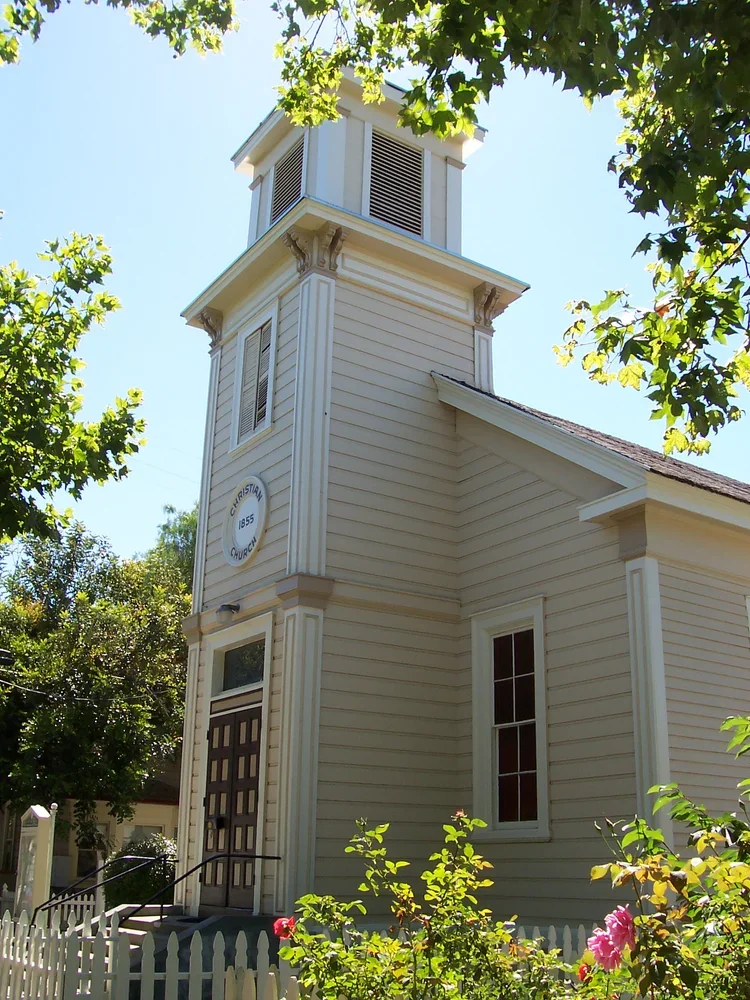
160 Fifth Street
(1857)
CHRISTIAN CHURCH
The oldest church still standing in Gilroy is the Christian Church which was built in 1857 on the west side of Church Street where Third Street is today. The congregation had been formed in 1855 by Reverend James King Rule. When Third Street was extended in 1886 the church building was moved on rolling logs to its present location of Fifth Street. The Christian Church continued to be active until the mid-1960s. In 1963 the church deeded its property to its statewide organization the Christian Church of Northern California and Nevada. In September of 1967 the Latin American Assembly of God purchased the church and grounds.
The architecture of the church has been called Greek Revival. The outstanding features include vertical double hung windows, the tall square tower with vertical shuttered vents at the entrance, and the wood slat vents. The rectangle building has clapboard siding, enclosed eaves, and a circular wood projection with the date 1855 inscribed on it. That year marked the founding of the congregation, although the church was actually built two years later.
The Gilroy Christian Church building has the distinction of being the oldest church in continuous use in Santa Clara County and is on the National Register of Historic Places. It is also thought to be the oldest framed church in northern California.
List of all map locations:
195 Fifth Street: Carnegie Library Building (William Weeks, 1910)
111 Fifth Street: Jessen-Menke House (William Weeks; Craftsman, 1912/1913)
7539 Eigleberry Street: Holloway House (William Weeks; Queen Anne Victorian, 1903)
55 Fifth Street: Old Fire Station (William Binder/William Radtke Builders, 1916)
7501-07 Monterey Street (Radtke Builder; Spanish Colonial Revival, 1928)
7515-17 Monterey Street: Thornton Building (Double brick arched facade, 1921)
7541-43 Monterey Street: Robinson Hardware (William Weeks, 1915)
7579-81 Monterey Street (Radtke Builder; Mediterranean Revival, 1925/1926)
7578-88 Monterey Street: Strand Theater (Reid Bros./Radtke Builders, 1921)
7568-74 Monterey Street (Radtke Builder; Neoclassic Details, 1928)
7560-62 Monterey Street: Elks Building (Albert Roller/Radtke Builders; Spanish Colonial Revival, 1931)
7550 Monterey Street: Gilroy Rubber Works (Radtke Builder;, Spanish Colonial Revival, 1919)
40-46 Martin Street: Radtke Building (Radtke Construction HQ, 1929)
7484-90 Monterey Street: Hersman Building (First National Bank; Radtke Builder, 1912)
7466-82 Monterey Street: Dispatch Building (Radtke Builder; Moderne Style, 1917)
7440 Monterey Street: Parisian Cleaners (1910/21)
7436 Monterey Street: Coast Counties Electric Building (1912/1925)
7400 Monterey Street: Old City Hall (Frank Delos Wolfe; National Register of Historic Places, 1905)
7390 Monterey Street: Ellis Garage (William Weeks; Mediterranean Revival, 1923)
7250 Monterey Street: Southern Pacific Railroad Depot (Mediterranean Revival, 1918)
7257-61 Monterey Street: Cherry Blossom Hotel (Spanish Colonial Revival, 1921)
7357Monterey Street: Porcella’s Music (1870’s)
7363-71 Monterey Street: Louis Hotel (Binder& Curtis/Radtke Builders; Neoclassic Style, 1921)
7397 Monterey Street: Milias Hotel (William Weeks; Mediterranean Revival, 1922)
60 West Sixth Street: Old Post Office (1920)
74 West Sixth Street: Veteran’s Hall (1949)
55 West Sixth Street: The Advocate Building (Radtke Builder, 1916)
7401 Monterey Street: Ellis Building (Oldest Building, 1872)
7445 Monterey Street: Chesbro Building (Radtke Builder; Neoclassic Style, 1917)
7451 Monterey Street: Johnson Drug Store (Palmer & Gurries; Mediterranean Revival, 1924)
7485 Monterey Street (Radtke Builder; Moderne Style, 1941)
60 Fifth Street: Weaver-Tremaine House (William Weeks; Queen Anne Victorian, 1900)
92 Fifth Street: American Legion Hall (Spanish Colonial Revival, 1926/1927)
7477 Eigleberry Street: Amos Robinson House (Neoclassic, 1882)
140 Fifth Street: Willey House (Folk Victorian/Classic Revival, 1857)
160 Fifth Street: Christian Church (National Register of Historic Places; Greek Revival, 1857)
An excellent resource for further information on historical building styles is American Architecture Since 1780: A Guide to the Styles by Marcus Whiffen.
For more information see the City of Gilroy Historic Context Statement for a very comprehensive, detailed city history.